
Howdy Readers 🥰
In this newsletter, you’ll find:
🫢Your TV Attribution is wrong
📢 Platforms Reshape Digital Advertising
👨💻 Tweet of the Day
If you’re new to Buyology then a hearty welcome to you, You’ve reached the right place alongside 50k+ amazing people, Before you forget, if someone forwarded this newsletter to you, don't forget to subscribe to our newsletter so you never miss out!
🫢Your TV Attribution is wrong
View-through attribution credits a TV or streaming ad for a conversion whenever someone was exposed to it and later bought, regardless of whether the ad actually caused the purchase.
Someone sees a streaming ad Tuesday and buys Thursday because a promotional email landed that morning, and view-through still hands the credit to TV.
The problem compounds because heavy TV advertisers tend to reach high-intent audiences who were reasonably likely to convert anyway, regardless of whether they saw the ad at all.
That means view-through doesn’t just occasionally misattribute a single conversion here and there. It systematically inflates TV’s apparent performance in exactly the direction that makes a weak or genuinely non-incremental campaign look like it’s working when it may be doing nothing at all beyond capturing demand that already existed.
The industry’s actual standard is shifting hard toward holdout-based incrementality instead, splitting the target audience into an exposed group and a genuinely unexposed control group, then measuring the real difference in outcomes between the two groups directly.
Roughly half of US marketers already run incrementality testing today, with adoption climbing fast, because “show me attribution” is no longer treated as sufficient by advertisers who’ve already been burned once by inflated view-through numbers that fell apart the moment anyone actually checked them properly.
The practical shift for any brand running or considering TV: ask the measurement question before the creative question. What’s the actual incrementality methodology behind the number being reported, a real holdout comparison or view-through exposure overlap dressed up to look like proof.
If it’s the latter, the reported ROAS may be measuring correlation with an already-converting audience, not causation from the ad itself.
PATTERN Beauty’s results with Tatari were built on exactly this standard: revenue impact measured from day one against real comparison data, not a view-through number sitting around waiting to be challenged and debunked later once someone finally asks the harder methodology question.
Before committing budget to any TV or streaming test, ask what methodology will prove it worked. Build demand with TV measured the right way from day one, not a number that only survives if nobody checks it too closely. You can book a free demo and build demand with TV before Q4 gets crowded.
Together with Omnisend
Your AI Knows What to Send. Omnisend Sends It.

You’ve got an AI that can talk strategy all day; what it can’t do is open your email platform, pull live data, and build the campaign while you watch
Omnisend fixes that. Connect it to Claude or ChatGPT and your AI starts doing the actual work. Real segments, emails drafted and ready to review, zero copy-pasting
See exactly what’s driving revenue in your account by campaign, by segment, by send
Find the automations and sequences you’re missing and what they’d be worth if you turned them on
Say “build it” and watch your AI create the segment, draft the email, and hand it back ready to send
150,000+ brands are already averaging $79 back for every $1 spent on this platform
Switching used to be the hard part. Omnisend migrates your lists, campaigns, and automations free in 5 days, so the only thing you’re really deciding is how long you’re okay leaving revenue on the table
Connect Omnisend and let your AI actually do something
📢 Platforms Reshape Digital Advertising
YouTube, Apple, and Google each introduced updates affecting how ads are shown, who can advertise, and how campaigns are built.
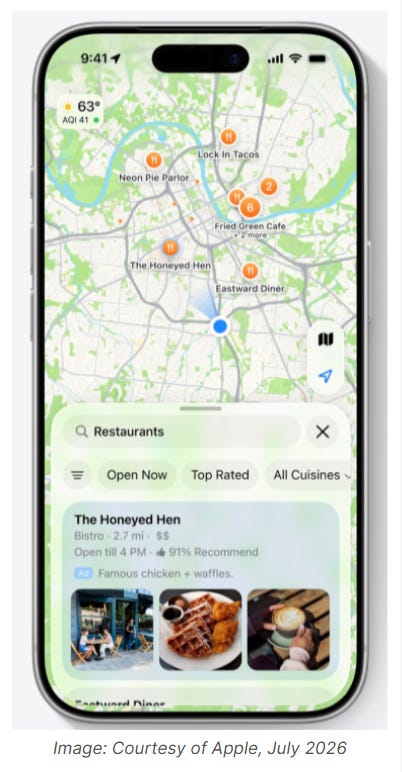
The Breakdown:
YouTube Tests More Ads - Users report 3 ads, breaks every 3–4 minutes, and longer unskippable blocks. More inventory could mean more ad slots, but heavier loads may quickly dilute attention.
Apple Maps Ads Near Launch - Apple Maps Ads are expected to launch soon in the U.S. and Canada with one sponsored pin per search, while excluding home services, bail bonds, and crypto ATMs. If you’re a restaurant, store, café, or other visit-based business, now is the time to claim and verify your listing to compete for that single placement.
Demand Gen Expands - Google now lets travel, real estate, and automotive advertisers use business data feeds in Demand Gen without Google Merchant Center. Structured data can automatically power more relevant dynamic ads while reducing manual creative updates.
Enhanced Brand Lift - Google introduced Enhanced Brand Lift Studies, measuring lifts as low as 1.2% instead of 2%. The option requires roughly 3× the budget but improves the chances of detecting a positive lift by 60%.
Platforms are evolving in different directions. More inventory, tighter local ad access, better automation, and stronger measurement mean advertisers will need to adapt their strategy for each ecosystem rather than treating them all the same.
🗝️ Tweet of the Day

Advertise with Us
Wanna put out your message in front of over 50,000 best marketers and decision makers?
Checkout our Partner Kit here🤝
At Buyology, we care about our readers and want to provide the best possible experience. That's why we always look for ways to improve our content and connect with our audience. It would be amazing if you could hit us up with feedback about our content or absolutely anything, we are always up for a chat 🥰
Thanks for your support, We'll be back with more such content 🥳