
Howdy Readers 🥰
In this newsletter, you’ll find:
🥴Why Your Influencer Program Isn’t Scaling (It’s Not the Creators)
🤖 Here Is Why ChatGPT Cites Some Pages and Ignores Others
👨💻 Quick Hits
If you’re new to Buyology then a hearty welcome to you, You’ve reached the right place alongside 50k+ amazing people, Before you forget, if someone forwarded this newsletter to you, don't forget to subscribe to our newsletter so you never miss out!
🥴Why Your Influencer Program Isn’t Scaling (It’s Not the Creators)
Brands hit the same wall six months into influencer marketing. The posts are going up. Some content is landing. But the program feels fragile, slow, and impossible to systematize. They blame the creators. The real problem is the infrastructure holding the program together.
Or more accurately, the lack of it.
Run a Dark Horse Seeding Round Before Your Main Campaign
Before you brief your primary creator list, seed five to eight micro creators with zero instructions. No talking points, no brand guidelines, just the product and a note saying you’d love to see what they do with it.
What comes back tells you which angles resonate naturally versus which ones you’ve been forcing. The creative directions that perform in that unscripted round become the brief for every creator after it.
Most brands write briefs based on what they want to say. This flips it. You’re letting the channel tell you what lands before you spend real budget finding out the hard way.
Map Your Creator Roster Against Your Paid Social Funnel
Your influencer content shouldn’t live in a separate channel. Every piece of creator content should have a predetermined role in your paid funnel before the creator is even briefed.
The top of the funnel gets the broad identity-driven storytellers. Mid-funnel gets the niche experts whose audiences are already problem-aware.
Retargeting gets the testimonial-style creators whose content feels like a peer recommendation rather than a post. When you brief with the funnel stage in mind, you stop producing content that has nowhere to go after it goes live.
Build a Creator Bench, Not a Creator List
Most brands treat influencer rosters like a fixed cast. Same creators, same cadence, same creative fatigue setting in around month three. The brands scaling past that build a bench.
Thirty to forty creators in various stages of relationship: some actively posting, some in a seeding phase, some dormant but warmed up and ready to activate when a new product drops or a campaign needs volume fast. The bench model means you’re never starting from zero. You’re always one brief away from output.
This is where infrastructure becomes the actual competitive advantage. Managing a bench of 30-plus creators across briefs, approvals, contracts, and payments manually is where programs collapse.
Insense removes that ceiling entirely. With 80,000+ vetted creators ready to brief, automated contracts and payments, lifetime usage rights on every collab, and first applications landing within 48 hours, you can run a bench program without adding headcount. You can book a free strategy call by May 8 and get a $200 platform credit toward your first campaign.
Let Losing Ads Pick Your Next Creators
Pull your bottom-performing paid social creatives from the last 90 days and find the pattern. Not in the creative itself, but in the audience segment where it underperformed.
That underperforming segment is a targeting gap, and a creator who speaks natively to that segment is worth more to you right now than another creator in a vertical that’s already working.
Most brands double down on what’s converting. The smarter play is using your paid data to find the pockets your current creator mix isn’t reaching.
The brands that scale influencer programs past six figures a month aren’t finding better creators. They’re building better systems around the ones they already have.
Together with AirOps
ChatGPT doesn’t cite simple content. It never did.

Most marketers are writing for readability. Shorter sentences, simpler words, easier skimming. ChatGPT is penalizing them for it.
AirOps studied 16,851 queries and 353,799 pages across 10 industries and tracked 20 signals to find out exactly what gets a page cited versus ignored.
Here’s what the data found:
Pages ranked in position 1 get cited 4x more than position 10. If you’re not on page one, you’re essentially invisible to AI.
Comprehensive guides are getting outperformed by focused 800-word pages. Everything you built for SEO may be working against you.
Pages aged 30-90 days hit the highest citation rate. Your older content is bleeding visibility silently.
The report breaks down all 20 signals with controlled comparisons across each. No theory. Just data on what ChatGPT actually responds to.
🤖 Here Is Why ChatGPT Cites Some Pages and Ignores Others
Ahrefs analyzed 1.4 million ChatGPT prompts to figure out what actually drives citation decisions, and the findings change how you should think about AI visibility.
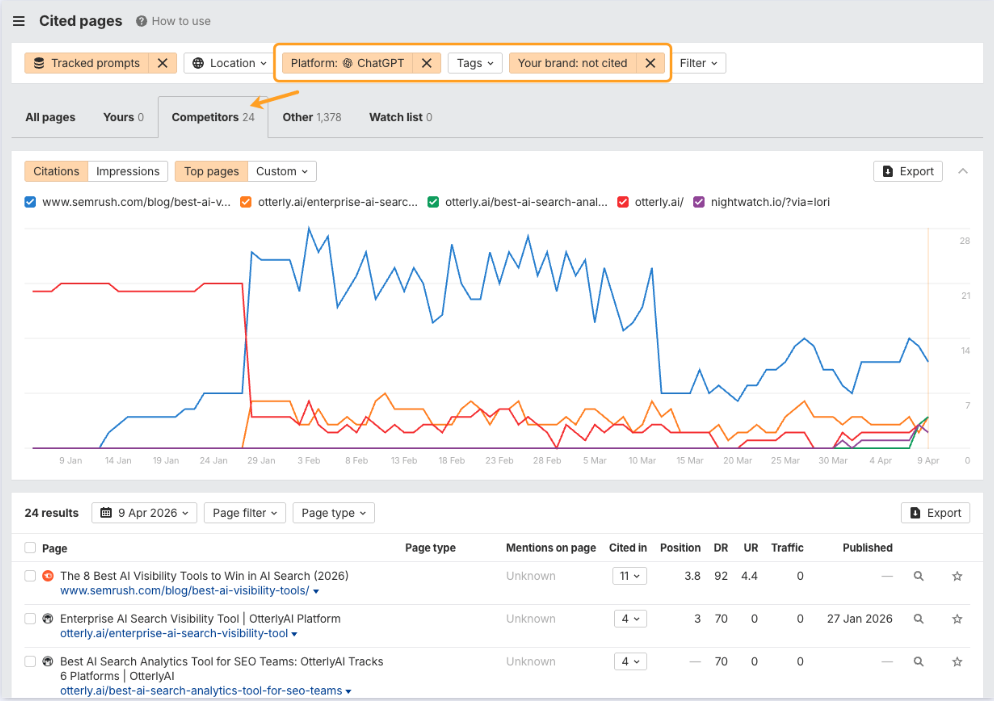
The Breakdown:
Search Index Wins - ChatGPT only cites about 50% of the pages it retrieves. The search ref_type dominates with an 88.46% citation rate, accounting for 88% of all cited URLs. YouTube sits at 0.51% and academia at 0.40%.
Reddit Gets Ghosted - ChatGPT pulls over 16 million Reddit data points, but cites it at just 1.93%. It uses Reddit to understand topics and build context, then credits a different source entirely. 67.8% of all non-cited URLs are from Reddit.
Title Decides Before Content - Before opening any page, ChatGPT uses the title, snippet, and URL as a gatekeeping layer. Pages that clear this filter get read. Pages that do not get discarded before their content is ever seen.
Fanout Queries Decide Everything - ChatGPT generates internal sub-questions from every prompt. Cited pages scored 0.656 cosine similarity against these queries versus 0.484 for non-cited pages. Pages whose titles match what ChatGPT is asking behind the scenes get cited.
Rank in search, write titles that answer ChatGPT’s internal sub-questions, and keep URLs clean, natural language slugs had an 89.78% citation rate versus 81.11% for opaque ones. The median cited page is 500 days old, but for news queries, freshness becomes the tiebreaker, with cited news pages averaging around 200 days old. Relevance still wins.
🗝️ Tweet of the Day

Advertise with Us
Wanna put out your message in front of over 50,000 best marketers and decision makers?
Checkout our Partner Kit here🤝
At Buyology, we care about our readers and want to provide the best possible experience. That's why we always look for ways to improve our content and connect with our audience. It would be amazing if you could hit us up with feedback about our content or absolutely anything, we are always up for a chat 🥰
Thanks for your support, We'll be back with more such content 🥳
I agree with the infrastructure problem in relation to influencer marketing - I disagree with it being fixed by a market-place platform. The industry has been there- and done that.