
Howdy Readers 🥰
In this newsletter, you’ll find:
🥲Your AI SEO workflow is incomplete
📺 YouTube in 2026: The Numbers Every Marketer Needs to Know
👨💻 Tweet of the Day
If you’re new to Buyology then a hearty welcome to you, You’ve reached the right place alongside 50k+ amazing people, Before you forget, if someone forwarded this newsletter to you, don't forget to subscribe to our newsletter so you never miss out!
🥲Your AI SEO workflow is incomplete
Every SEO workflow being shared right now is built on the same logic: use Claude or ChatGPT to do keyword research, generate outlines, write meta descriptions, draft outreach emails. The work gets faster.
The blind spot is that the same engines being used as productivity tools are also becoming the search surface buyers use. Founders are optimizing content for Google with AI while their buyers are increasingly asking ChatGPT instead, and content built for Google ranking doesn’t automatically get cited in AI answers.
Audit What Percentage Of Your Category’s Search Is Shifting To AI Engines
Run the same buyer queries through Google and through ChatGPT, Perplexity, and Claude. Document which surface returns your brand, which returns competitors, and which returns neither.
For most B2B and considered-purchase B2C categories, AI engines now handle 20-40% of research-stage queries, climbing fast. If your brand is invisible on those surfaces, you’re losing 20-40% of the consideration set before the funnel begins.
Separate The AI-Tool Workflow From The AI-Engine Workflow Explicitly
These are two different programs and should be treated that way.
The AI-tool workflow uses Claude and ChatGPT as productivity multipliers for SEO work that still optimizes for Google. The AI-engine workflow optimizes the content itself for citation in AI engines, which requires structural patterns that Google doesn’t reward. Most teams collapse these into one workflow and lose on both surfaces. AirOps analyzed 15M+ AI queries and built the exact playbook Ramp, Carta, and Webflow are running right now, including structural patterns, refresh cadences, off-site signals, and a 90-day action plan. You can get the playbook here!
Build A Content Strategy That Wins Both Surfaces
Content can earn Google rankings and AI citations simultaneously, but only if the structural requirements of both are designed in from the start. Retrofitting AI-engine optimization onto Google-first content is harder than building for both upfront.
The dual-surface checklist: Google-first elements (keyword density, internal linking, meta descriptions) layered with AI-engine elements (clear heading hierarchies, comparative claims, structured Q&A sections, quarterly refresh). The two layers coexist on the same page, but require different inputs at the brief stage.
Most founders are using AI to write content. The brands compounding are using AI engines as a search surface their content needs to win.
📺 YouTube in 2026: The Numbers Every Marketer Needs to Know
YouTube now has 2.58 billion monthly active users, sessions average 14 minutes and 29 seconds, nearly double TikTok’s 9 minutes, and it is the top platform for product reviews across every generation. For marketers, this is where purchase decisions get made.
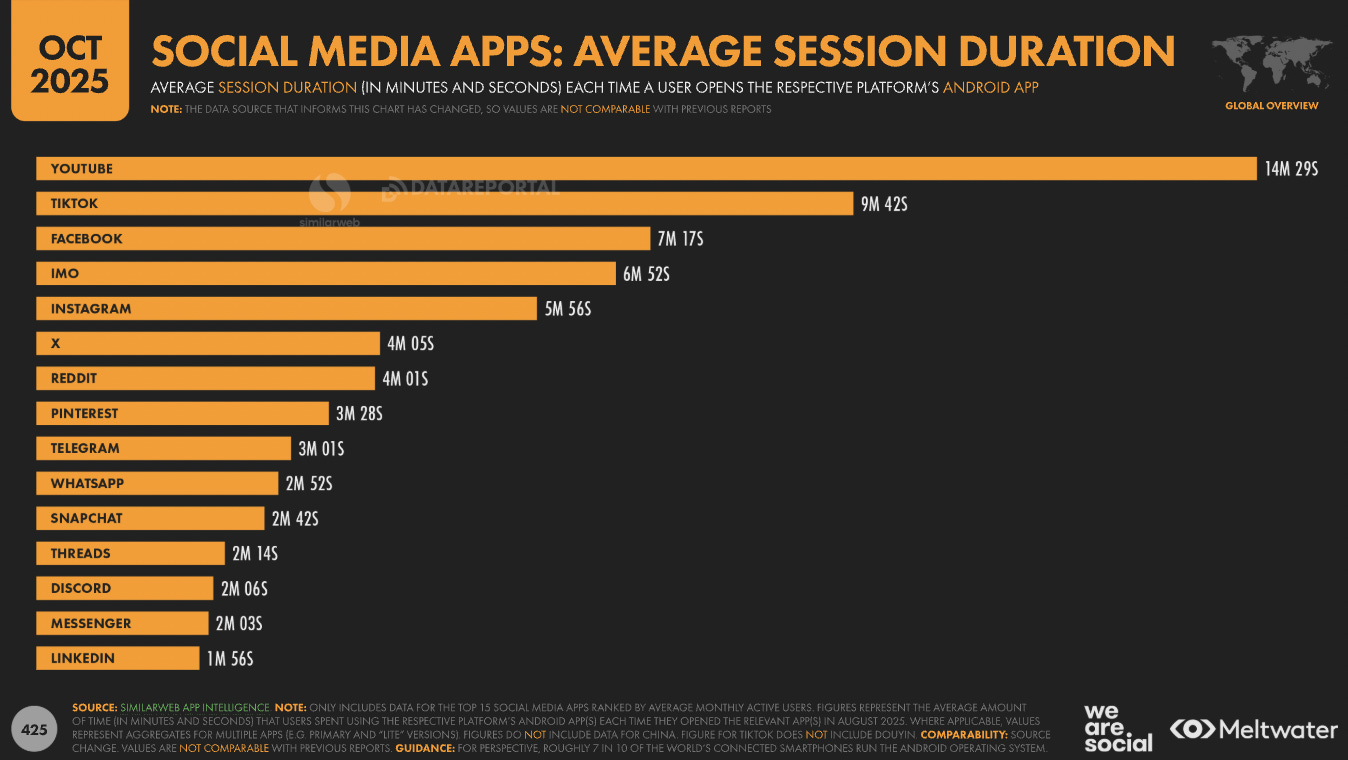
The Breakdown:
Shorts Is a Massive Discovery Engine - 200 billion daily views on Shorts, with trending ones running 50-60 seconds. 51% of Gen Z boys and 43% of Gen Z girls made a purchase after seeing a YouTube Shorts ad.
Gen Z Lives Here and Buys Here - 84% of Gen Z have a YouTube account. YouTube ads drove purchases more than TikTok or Facebook, with 67% of Gen Z teens seeing ads for products they asked parents to buy on YouTube.
In-Feed Ads Outperform Everything Else - In-feed ads hit a 1-3% CTR against a platform average of 0.65%. Average CPM sits between $5-$10, with the cheapest windows being January-February and July-August.
Brands Are Increasing Spend in 2026 - 56% of companies plan to put more budget into YouTube this year, making it the fifth most prioritized platform for marketer investment globally.
With ad revenue crossing $40 billion in 2025 and 24% of users going to YouTube specifically to find new products, the platform has moved well beyond entertainment. For brands not yet treating YouTube as a full-funnel channel, the window to get ahead of the spend wave is closing fast.
🗝️ Tweet of the Day

Advertise with Us
Wanna put out your message in front of over 50,000 best marketers and decision makers?
Checkout our Partner Kit here🤝
At Buyology, we care about our readers and want to provide the best possible experience. That's why we always look for ways to improve our content and connect with our audience. It would be amazing if you could hit us up with feedback about our content or absolutely anything, we are always up for a chat 🥰
Thanks for your support, We'll be back with more such content 🥳