
Howdy Readers 🥰
💪 Why Symptoms Sell Faster
🧾 How SMB Search Is Shifting in 2025
🚀 Tweet of the Day
If you’re new to Buyology then a hearty welcome to you, You’ve reached the right place alongside 50k+ amazing people, Before you forget, if someone forwarded this newsletter to you, don't forget to subscribe to our newsletter so you never miss out!
Together with Tatari
Why Winning DTC Brands Are Getting Pickier About Their TV Partners

If you’ve been eyeing TV for 2026, you’ve seen the flood: hundreds of platforms promising to “unlock CTV for your brand.” Here’s what they’re not saying: who you pick determines whether TV becomes a growth channel or an expensive experiment.
Most new players are programmatic-only – limited transparency, low-quality supply, and measurement that crumbles the second you scale.
The brands actually winning on TV (Jones Road Beauty, Tecovas, Ridge Wallet, Calm) use partners who offer:
Not just programmatic, but linear, streaming, and direct publisher inventory
Full visibility into where ads ran
Outcomes measurement that actually works at scale
2026 will reward marketers who are thoughtful about their TV partners. The space is crowded, but the right choice actually moves the needle.
And don’t forget to gut-check those shiny offers. Free ad credits? Performance guarantees? If it sounds too good to be true, it is.
Start smart or switch to a reliable partner: Tatari.tv
💪 Why Symptoms Sell Faster
A symptom is not a pain point. A symptom is a timestamp. That distinction explains why symptom-first ads keep outperforming ingredient stacks, founder intros, and even polished proof-led openers. Symptoms convert because they collapse time.
They make the buyer feel the problem is happening today, not someday. When time collapses, action becomes rational. This is not empathy. This is temporal engineering.
Step 1. Build a Symptom Timestamp Map
Most brands write symptoms from imagination. Operators harvest them from reality using four sources: one-star reviews, refund reasons, support tickets, ad comments and DMs. Extract the moment in each line, not the complaint. The micro-scene where the buyer realized, This is a problem.
Examples: “I woke up tired again.” “3 pm hit and my brain shut off.” “I snapped at someone for no reason.” “I stared at the cart and thought, Will this even work?” “I avoided photos because my face looked puffy.”
These are not features. They are clocks. Cluster them into 6 to 10 repeatable “time pockets” your buyer lives in, like morning, mid-day crash, late-night doom scroll, post-meal regret, social anxiety, work performance, and intimacy. That is the map.
Step 2. Write the Symptom Ladder, not a symptom hook
Most symptom ads fail because they stop at annoyance. High performers ladder symptoms in three steps: Annoyance (the daily paper cut), Risk (the cost starts showing up), Identity loss (recognition that something is slipping). Example:
Annoyance: “Eight hours of sleep, still tired.”
Risk: “Coffee is not fixing it anymore, just masking it.”
Identity loss: “The scary part is this is becoming normal.”
Annoyance earns the stop. Risk creates seriousness. Identity loss creates motion.
Step 3. Use the Proof Seal, not proof first
Proof-first triggers a verification loop, causing comparison and delay. Delay expands time, and expanded time kills purchases. The sequence is timestamp first, ladder second, proof third. The Proof Seal is one tight unit:
Outcome: “Most people feel the difference within seven nights.”
Mechanism: “Because it targets the wake-ups, not just sleep onset.”
Constraint: “If the issue is caffeine after 2 pm, fix that too.”
The constraint is the trust cheat code.
Step 4. The 9-angle matrix that finds a scalable winner
Build nine ads from the same product using three timestamps (morning, mid-day, night) and three ladders (annoyance, risk, identity). These are meaningfully different angles, not cosmetic variations. One usually becomes the account’s “gravity well.”
Why ingredient-led ads lose
Ingredients are slow language. They invite analysis, which pushes decisions into next week where intent dies. Symptom gravity shortens the distance between today and feeling normal again.
🧾 How SMB Search Is Shifting in 2025
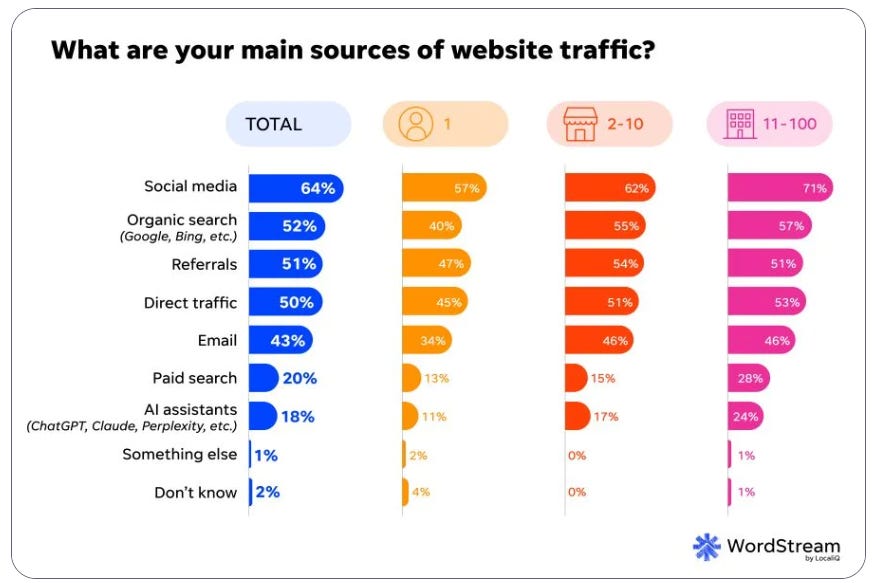
Small businesses are navigating the most fragmented search landscape in history. Traffic now comes from Google, social platforms, AI engines, and directories, making visibility harder to control. This report shows where SMBs are gaining, losing, and adapting as search behavior rapidly evolves.
The Breakdown:
1. Website Importance - Websites remain core to SMB growth, with 94% calling them important and 69% relying on them for leads, yet 35% still struggle to drive and convert traffic. Despite rising social and AI channels, a strong site remains the center of digital revenue.
2. Social Outpaces SEO - Social media now drives more traffic than SEO (64% vs. 52%), aligning with consumer behavior where most product discovery happens on platforms like Instagram and TikTok. SMBs increasingly depend on social visibility, even using it as the primary alternative to having a website.
3. SEO Holds but Shifts - SEO remains effective for 72% of SMBs, yet 40% report traffic losses from Google updates and AI search. Algorithm volatility and content demands force SMBs to rethink SEO as one piece of a broader multi-channel strategy rather than a standalone engine.
4. AI & GEO Pressure - Nearly half of SMBs are now familiar with GEO, and 50% track AI referrals, signaling early adaptation to generative search. Competitor citations, attribution challenges, and declining organic traffic push SMBs to optimize homepage, product, and about pages for AI answers.
Search has splintered into SEO, social, and AI engines, and SMBs must optimize across all three to stay discoverable. Google still drives intent, but AI summaries and social discovery now shape early consideration, making diversified visibility essential for sustainable 2025–2026 growth.
Together with Galactic Fed
Get a Senior Growth Team to Review Your Marketing Strategy.

Galactic Fed’s senior growth team has scaled 600+ brands like Varo, Edible, and Quiznos.
And now they’re opening a limited number of free 1:1 sessions with these growth geniuses to help ambitious founders find their next breakthrough.
They’ll dig into your traffic, funnels, and ad performance to surface what’s working, what’s wasting money, and where your fastest growth levers really are.
Spots are limited, but one session could change your next quarter or your entire fiscal year.
🗝️ Tweet of the Day

Advertise with Us
Wanna put out your message in front of over 50,000 best marketers and decision makers?
Checkout our Partner Kit here🤝
At Buyology, we care about our readers and want to provide the best possible experience. That's why we always look for ways to improve our content and connect with our audience. It would be amazing if you could hit us up with feedback about our content or absolutely anything, we are always up for a chat 🥰
Thanks for your support, We'll be back with more such content 🥳