
Howdy Readers 🥰
In this newsletter, you’ll find:
🥳 You’re getting three ads. You should be getting twenty-five.
🔎 Google and Bing are testing new ways to stand out in search
👨💻 Tweet of the Day
If you’re new to Buyology then a hearty welcome to you, You’ve reached the right place alongside 50k+ amazing people, Before you forget, if someone forwarded this newsletter to you, don't forget to subscribe to our newsletter so you never miss out!
🥳You’re Getting Three Ads. You Should Be Getting Twenty-Five.
The difference between a creator program that plateaus and one that compounds is not spend. It is how many variants one brief produces.
Most brands are at a 1:3 ratio without knowing it. The brands pulling away are at 1:20.
Check Your Ratio First
Pull your last 10 creator briefs. Count the finished ad variants each one produced.
Same budget. Same briefs. Twenty times the algorithm testing surface. The ratio is the leverage, and most programs have never measured it.

The Brief Is Where The Multiplication Starts
A brief asking for “one ad about the product” produces one ad. A brief asking for raw footage across specified scene types produces the asset pool from which 15-25 finished ads get built.
The restructure is one change: make the deliverable the asset library, not the finished ad.
Every brief specifies raw material requirements instead:
5-7 product close-ups
3-4 lifestyle angles
2-3 testimonial framings
B-roll across 3 different contexts
Insense makes this structure cost-effective at scale. One brief gets you numerous raw footage clips with lifetime usage rights, delivered in 14 days or less, built to produce the asset pool the multiplication requires. You can book a free strategy call and get $200 for your first campaign.
The Post-Production Workflow That Builds The Twenty-Five
The multiplication happens in editing, not in shooting. Most brands skip this step because the brief never asked for the raw material.
Three editing dimensions. Same footage. Twenty-plus structurally distinct ads.
Hook variation: 3-5 different first frames cut from the same footage. Each tells the algorithm something different about who the ad is for.
Pacing variation: 15s, 30s, and 60s cuts. Different placements, different audience states, different funnel stages.
Angle variation: product-led, creator-led, and problem-led versions of the same script. Three different trust currencies from one shoot.
The variant-to-brief ratio is the multiplier on every dollar spent on creators. Most programs have never calculated it. Calculate it today.
Together with Planable
The AI event for marketing leaders: BreakingSilos 2026 Tomorrow

AI is answering for your brand. You didn’t write those answers.
AI tools are already forming opinions about your brand using signals you never curated. Recommending competitors. Shaping buyer decisions before your funnel even starts.
BreakingSilos 2026 brings together the practitioners who’ve cracked this. Free. Online. Tomorrow.
The sessions go deep on why AI forms brand opinions from signals you never controlled, where attribution is silently bleeding your BOFU performance, and what a cross-channel signal strategy actually looks like in 2026.
You’ll leave with:
A clear map of how AI decides which brands to surface and what inputs actually move the needle
A cross-channel framework connecting your SEO, social, PR, and content signals into one strategy
The language and data to get your org aligned around ecosystem thinking
30+ sessions. 70+ speakers. Zero vendor pitches.
Reserve your free spot today and find out where the signal breaks.
🔎 Google and Bing are testing new ways to stand out in search
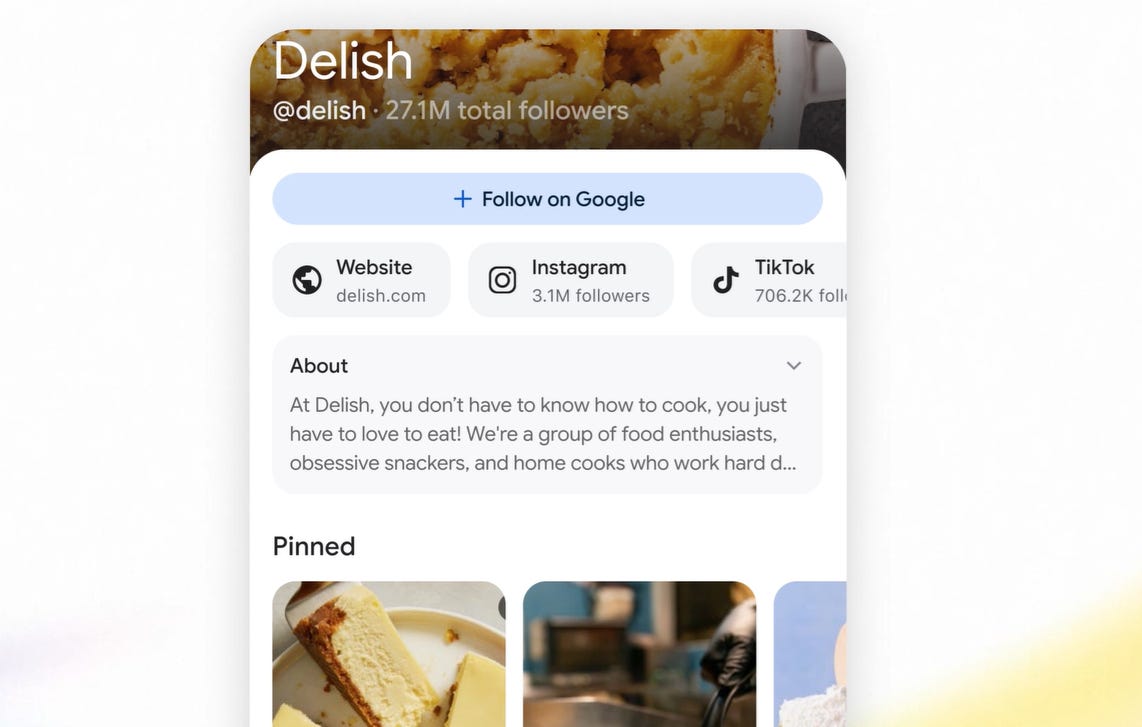
Google and Microsoft both rolled out search-focused experiments this week. Google is giving creators and publishers their own profile pages inside Search, while Bing is testing a visual change designed to make top ads more prominent.
The Breakdown:
Creators get their own Search presence - Google introduced Search Profiles, a dedicated space where eligible creators and publishers can showcase articles, videos, social content, websites, and other key information directly in Search.
Google adds a new audience-building tool - Users can follow creators directly from these profiles, increasing the chances of seeing their content in Google Discover and creating a new distribution channel beyond traditional search rankings.
Access starts with large audiences - Search Profiles are launching in the U.S. first and currently require at least 100,000 followers on YouTube, Instagram, or X, or 300,000 followers on TikTok to qualify.
Top sponsored results get more attention - Microsoft Bing is experimenting with larger favicons for the first sponsored ad position, making paid listings visually stand out more than lower ads and organic results.
Search results are becoming more visual and identity-driven. Google is giving creators new ways to build audiences directly inside Search and Discover, while Bing is testing subtle design changes that could make paid placements more noticeable and potentially more effective.
🗝️ Tweet of the Day

Advertise with Us
Wanna put out your message in front of over 50,000 best marketers and decision makers?
Checkout our Partner Kit here🤝
At Buyology, we care about our readers and want to provide the best possible experience. That's why we always look for ways to improve our content and connect with our audience. It would be amazing if you could hit us up with feedback about our content or absolutely anything, we are always up for a chat 🥰
Thanks for your support, We'll be back with more such content 🥳