
Howdy Readers 🥰
In this newsletter, you’ll find:
🪄The Four-Question Audit for Where Your Emails Actually Land
📱 New Research On Social Commerce
👨💻 Tweet of the Day
If you’re new to Buyology then a hearty welcome to you, You’ve reached the right place alongside 50k+ amazing people, Before you forget, if someone forwarded this newsletter to you, don't forget to subscribe to our newsletter so you never miss out!
🪄The Four-Question Audit for Where Your Emails Actually Land
Gmail now sorts incoming mail with more precision than a single Promotions tab ever allowed, splitting purchase-related content into its own dedicated space, separate from general marketing entirely. An email that reads as transactional lands somewhere a customer actively checks with intent, since they’re looking for exactly that kind of update when they open it.
An email that reads as promotional competes in a crowded tab most people skim once, if that, before moving on. Getting classified into the wrong one costs real attention that formatting alone can win back.
Run these four checks against the current post-purchase sequence before assuming the content itself is the problem.
Does the subject line read as clearly transactional or promotional? “Your order shipped” reads one way, clean and expected. “Your order shipped, plus 20% off your next order” reads as both at once, and that kind of mixed signal in the subject line is often the first thing that risks miscategorization into the wrong tab entirely.
Does the formatting match what a receipt actually looks like structurally? Order numbers, shipping details, and delivery windows presented cleanly signal transactional content on their own, independent of the copy. Heavy promotional styling layered onto a shipping update works against that signal even when the underlying content is genuinely just an update.
Is a promotional offer riding inside an otherwise transactional email? A cross-sell block stapled to the bottom of a shipping notice turns one clean signal into a mixed one instantly. Splitting it into two separate sends, a clean transactional message and a separate promotional follow-up, protects both pieces rather than risking either.
Would a customer searching for this specific email later actually find it useful on its own? An email built to be found and referenced afterward, an order number, a delivery date, functions differently than one built purely to be read once and clicked immediately.
Running this audit by hand means reviewing every post-purchase send individually against all four questions, product line by product line. Omnisend now works with Claude and ChatGPT, and can run the same four-question check against the live flow in a single prompt, flagging exactly which sends need splitting before the next order goes out.
Brands on Omnisend generate an average of $79 for every $1 spent, with free migration in five days and pricing up to 35% lower than Klaviyo’s.
You can get started with the ready-made prompts here and find out which sends are quietly landing in the wrong place right now.
Together with Billo
Most hooks fail in 2 seconds. These 3 types don’t.

Billo pulled 6 months of creator ad data and tagged every top performer by hook type. Most of what’s in your current brief barely showed up.
Authentic Moment hooks made up over a quarter of top performers alone, and most had no script at all
Audience Call-out hooks skipped the product completely in line one. Just named the viewer. “Husbands.” “Hockey mom.”
List hooks, FOMO countdowns, and “forget X, try Y” setups were almost nowhere in the top tier
If your brief leans on that last one, you’re fighting for attention exactly where people tune out fastest.
The breakdown has every hook type plus the actual lines that made the top tier, so you can steal the structure instead of guessing at it.
Read it before your next round of creator ads.
📱 New Research On Social Commerce
Two new studies show that AI is becoming part of every marketer’s workflow, while social media continues to dominate product discovery without becoming the preferred place to buy.
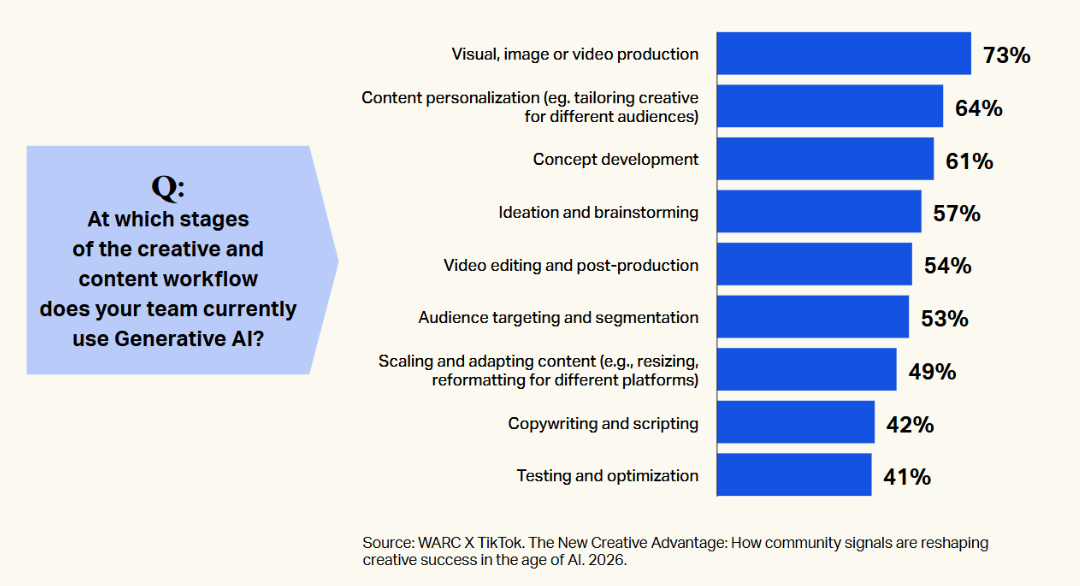
The Breakdown:
AI Speeds Up Creation - The TikTok-WARC report found 90% of marketers say GenAI is now a key part of creative development and 72% use it regularly. It’s used most for visual, image, and video production (73%), while only 42% rely on it for copywriting and scripting.
Culture Still Wins - The report found 88% of marketers are creating more content with AI, but only 45% say quality has improved significantly. It also found 1 in 3 marketers believe richer audience and cultural signals would help AI produce better creative.
Discovery Beats Checkout - An ESW survey of 23,000 shoppers found 62% of consumers are influenced by social platforms, but only 6% prefer buying there, with many choosing trusted brand or retailer websites instead.
Trust Drives Purchases - The research shows shoppers increasingly discover products on social media, validate them through reviews or AI tools, and then complete purchases on websites they trust, making trust a bigger driver of conversions than discovery.
The research points to a clear split in digital marketing. AI is making content production faster, but relevance still depends on human and cultural insight. At the same time, social platforms are winning discovery, while trusted websites remain the preferred destination for completing purchases.
🗝️ Tweet of the Day

Advertise with Us
Wanna put out your message in front of over 50,000 best marketers and decision makers?
Checkout our Partner Kit here🤝
At Buyology, we care about our readers and want to provide the best possible experience. That's why we always look for ways to improve our content and connect with our audience. It would be amazing if you could hit us up with feedback about our content or absolutely anything, we are always up for a chat 🥰
Thanks for your support, We'll be back with more such content 🥳