
Howdy Readers 🥰
If you’re new to Buyology then a hearty welcome to you, You’ve reached the right place alongside 50k+ amazing people, Before you forget, if someone forwarded this newsletter to you, don't forget to subscribe to our newsletter so you never miss out!
Together with Omnisend
How healthy is your email setup, really?

You probably know your open rate. But do you know how healthy your email marketing setup actually is?
Now that Omnisend works with Claude and ChatGPT, all it takes is a simple prompt.
Ask Omnisend AI to score your account out of 100 based on campaign cadence, automation coverage, and catalog completeness, then list the top three areas to improve.
In seconds, you’ll get a clear picture of how your account is performing and where to focus next.
Not yet an Omnisend user? Brands using Omnisend generate an average of $79 for every $1 spent. Migration is free and takes up to five days, while pricing is up to 35% lower than Klaviyo’s.
Get started with ready-made prompts.
📊 Amazon Is Already Running Your Diagnostic. It’s Just Not Sharing the Results.
The instinct when conversion is flat is to run a manual check: split CVR by traffic source, Sponsored Products against organic, and see which one is dragging the number down.
That’s a genuinely useful test. It’s also not the full picture, because A10 doesn’t wait for a seller to run it manually. The algorithm reads the gap between PPC conversion rate and organic conversion rate as a relevance signal on its own, continuously, whether or not anyone on the team has ever pulled that comparison.
Buyers arriving through PPC converting at a meaningfully lower rate than buyers arriving through organic search isn’t just a symptom a seller might eventually notice on their own schedule.
It’s an input A10 is already weighing when deciding organic placement, which means a persistent gap isn’t sitting quietly waiting to be discovered whenever it’s convenient. It’s actively suppressing organic rank in real time, every day the gap exists, independent of whatever conclusion the seller eventually reaches about it or how long that takes.
This changes the urgency of running the check, not just the value of running it. A seller who assumes the diagnostic is optional, something to get to once ACoS looks concerning, is missing that the algorithm has already drawn its own conclusion and started acting on it weeks or months earlier.
The manual split still matters, since it tells a seller which side of the gap to fix first. What most sellers miss is that the gap itself is being read and penalized continuously, in the background, long before anyone gets around to running the check that would have revealed it.
Closing the gap means bringing organic-quality intent to the listing from outside Amazon, buyers who convert well because they arrived already wanting the specific product, not because an ad happened to catch them mid-scroll.
Stack Influence sources exactly that: creators who purchase the ASIN with their own money and convert like genuinely interested buyers, not ad-driven traffic. You can book a free demo call here.
Run the split this week regardless, since it still tells a seller exactly where to point the fix once the gap is confirmed. But the number that should actually worry a seller isn’t what the split reveals when it finally gets run. It’s how long the gap had already been sitting open, quietly costing organic rank, while nobody on the team thought to check.
📈 ChatGPT Ads And Google Ads Get Major Marketing Upgrades
OpenAI and Google have announced new advertising platform updates aimed at giving marketers better campaign optimization, measurement, and AI-powered management tools.
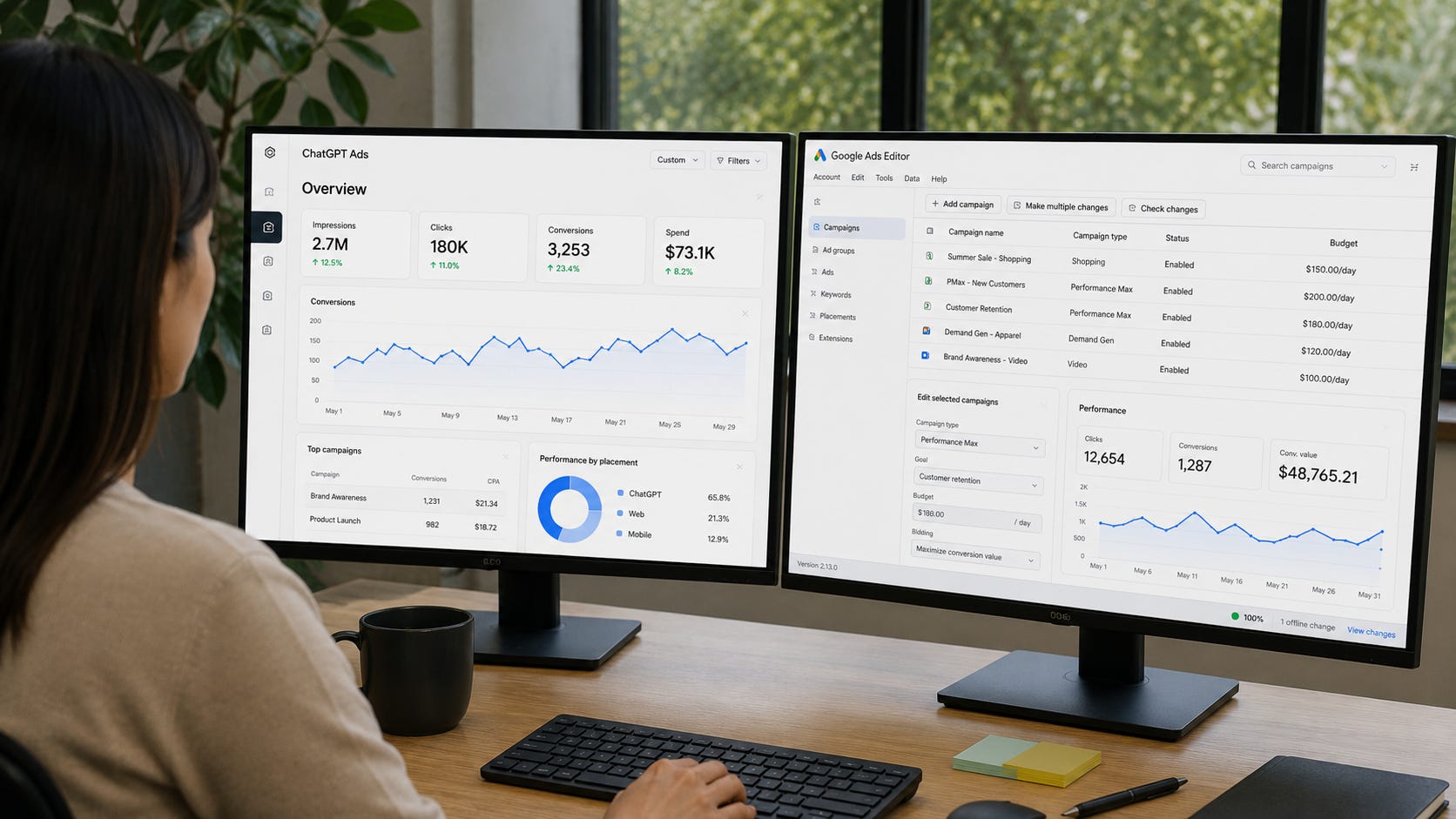
ChatGPT Ads Expands Performance Features: ChatGPT Ads now supports conversion-optimized CPC campaigns, automatic budget pacing, average daily budgets, geographic exclusions, improved conversion attribution, and new integrations with AppsFlyer and Adjust for mobile app measurement.
Better Automation For Advertisers: The platform also adds bulk API support for managing campaigns at scale and refreshed product feed ads with pricing and star ratings, making campaign management more efficient.
Google Brings More AI To Ads Editor: Google Ads Editor 2.13 adds AI Max support for Shopping campaigns, Customer Retention Goals for Performance Max, Demand Gen Maps placements, Channel Performance reporting, and AI-generated content disclosure controls.
Why It Matters
Both updates strengthen their advertising ecosystems by giving marketers more automation, better measurement, and AI-powered optimization, making it easier to manage and scale performance campaigns across both platforms.
🗝️ Tweet of the Day

Advertise with Us
Wanna put out your message in front of over 50,000 best marketers and decision makers?
Checkout our Partner Kit here🤝
At Buyology, we care about our readers and want to provide the best possible experience. That's why we always look for ways to improve our content and connect with our audience. It would be amazing if you could hit us up with feedback about our content or absolutely anything, we are always up for a chat 🥰
Thanks for your support, We'll be back with more such content 🥳