
Howdy Readers 🥰
In this newsletter, you’ll find:
😲That UGC Idea Failed in Statics?
🧩 Google Calls Out Quiet Technical Killers
🚀Tweet of the Day
If you’re new to Buyology then a hearty welcome to you, You’ve reached the right place alongside 50k+ amazing people, Before you forget, if someone forwarded this newsletter to you, don't forget to subscribe to our newsletter so you never miss out!
Together with Grapevine
The UGC Engine That Quietly Beats Your Ads

Branded creative looks incredible in a deck, but Q1 is where it quietly stops paying for itself. CPAs creep up, testing slows down, and every “pretty” ad becomes a bet you can’t afford to keep making.
Grapevine solves that with a done-for-you UGC engine designed to outperform the ads you’re running now quietly. No chasing creators. No contract chaos. No wasted cycles.
Grapevine handles it all. Just authentic content plugged into your paid social flows, and the numbers prove it works.
Editorial whitelisting campaigns reduced CPAs by up to 40%, unlocking immediate margin gains.
Benchmarks confirm Grapevine ads outperform branded creative by 25%+ across platforms.
The after-state? Faster launches, cheaper acquisitions, and a UGC pipeline that compounds wins while your team focuses only on scale.
Book a strategy call by February 27th for $500 off your first campaign!
😲That UGC Idea Failed in Statics?
Some ads get worse the moment you try to scale them responsibly.
You diversify formats, rotate creators, change containers, and do all the things the platform implicitly asks for. Similarity warnings drop, delivery unlocks, and the account looks healthier on paper. Then efficiency softens just enough to make you hesitate.
That outcome isn’t random. It’s diagnostic.
What’s actually happening is simple: creative diversification doesn’t just expand reach, it changes how trust is being generated, and not every idea survives that shift.
Every ad format carries a different trust shortcut.
A creator-led video leans on relatability. A newsletter-style static leans on authority. A lifestyle visual leans on aspiration. When an idea works in one of those environments, it often borrows credibility from the container itself, not just the message.
The cost of ignoring this shows up fast. Take an angle that converts well in UGC and strip it into a static. If performance drops, it’s not because statics “don’t work.” It’s because the idea relied on delivery to feel sincere, and once that layer was removed, the persuasion collapsed.
This is why creator swaps sometimes underperform even when the script stays the same.
Creators aren’t interchangeable distribution pipes. They’re context. Their audience expectations, tone, and perceived authority all shape how the message is processed. An idea that feels helpful from one person can feel transactional from another, even if the words are identical.
The fix isn’t to avoid creator rotation. It’s to treat rotation as a test of whether belief transfers across social frames. If it doesn’t, the idea is narrower than it looked.
This is where the iteration framework actually earns its keep.
Turning a static into motion tests whether the idea holds without explanation. Rebuilding the same message inside a different visual world tests whether credibility comes from the copy or the setting.
Recreating a video with another creator tests whether trust is portable. Stripping a video down into a static tests whether performance was coming from acting, editing, or the belief itself.
Used this way, iteration isn’t about multiplying ads. It’s about locating structural weakness before you spend into it.
The strategic payoff is clarity.
Ideas that survive multiple containers scale cleanly because they’re not dependent on a single trust mechanism. Ideas that don’t are still useful, but only inside the context they were born in.
Once you treat creative diversification as pressure testing instead of optimization, you stop chasing freshness and start building ads that hold up under real scrutiny. That’s when scaling feels deliberate instead of fragile.
🧩 Google Calls Out Quiet Technical Killers
Google highlighted two technical problems that quietly hurt performance without obvious warnings. One affects how accurately Google Ads measures results, and the other impacts how search engines crawl, index, and understand websites.
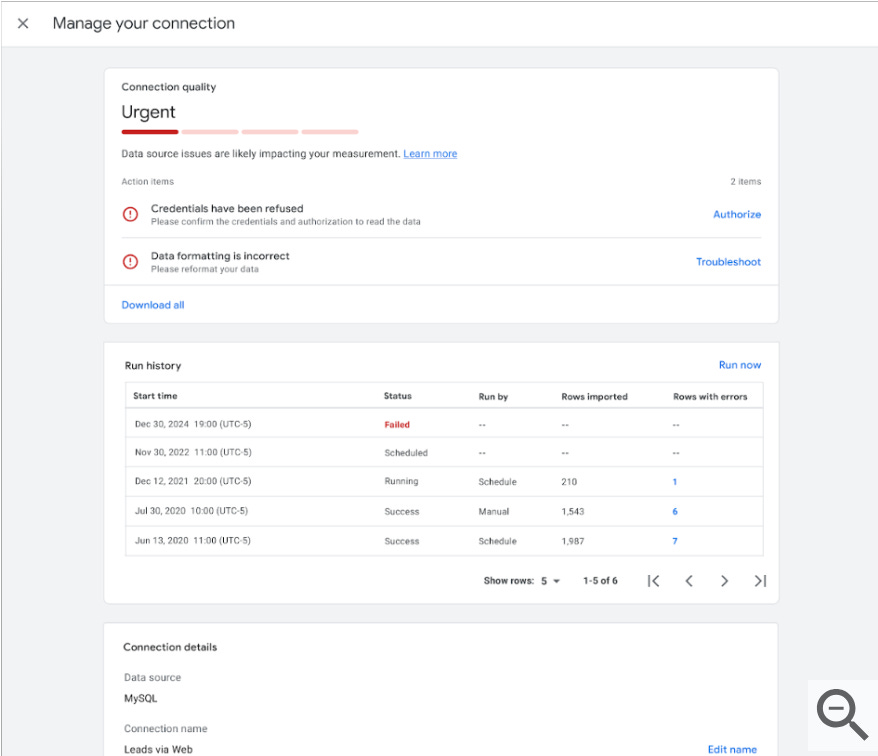
The Breakdown:
1. Ads Data Breaks Silently - Google Ads’ data source diagnostics tool helps spot broken connections before they cause damage. Clear statuses like Excellent, Needs attention, or Urgent show whether your data is flowing or failing.
Most issues come down to basics: expired credentials, missing access, incorrect data formatting, deleted sources, or transaction IDs that don’t match your site tag. Left unfixed, these errors quietly corrupt reporting and optimization.
2. Most Crawl Problems Are Self-Inflicted - Google says faceted navigation and action parameters cause about 75% of crawl issues, creating near-infinite URLs that trap bots, overload servers, and slow indexing.
Google’s report shows 50% of issues come from filters, 25% from action parameters, and the rest from tracking tags, plugins, and malformed URLs. Clean URL rules protect crawl efficiency and canonical signals.
The common thread is neglect. Broken data connections and messy URLs don’t fail loudly, but they slowly drain performance. Regular checks on tracking setups and URL rules can prevent measurement blind spots, server strain, and long-term SEO damage.
Together with The Shift
The AI Newsletter That Solves Problems, Not Creates Them
AI can do a lot, but most newsletters leave you wondering what’s actually worth trying.
That’s where The Shift comes in. They don’t just tell you “what’s new” in AI.
Every edition answers one question: What can you do with AI today that saves you time, money, or effort?
You’ll see real-world examples, step-by-step mini-guides, and instantly usable prompts, plus free access to 3,000+ AI tools and top free AI courses so you can apply what you learn right away.
No hype, no wasted time, and no “just in case” news. If it’s in The Shift, it’s because it can make your work better today.
Subscribe to The Shift now - it’s free!
🗝️ Tweet of the Day

Advertise with Us
Wanna put out your message in front of over 50,000 best marketers and decision makers?
Checkout our Partner Kit here🤝
At Buyology, we care about our readers and want to provide the best possible experience. That's why we always look for ways to improve our content and connect with our audience. It would be amazing if you could hit us up with feedback about our content or absolutely anything, we are always up for a chat 🥰
Thanks for your support, We'll be back with more such content 🥳