
Howdy Readers 🥰
In this newsletter, you’ll find:
🧠 Motivation > Demographics: Start With One Product, Then Split the Why
📊 ChatGPT Is Quietly Becoming an E-commerce Channel
🚀Tweet of the Day
If you’re new to Buyology then a hearty welcome to you, You’ve reached the right place alongside 50k+ amazing people, Before you forget, if someone forwarded this newsletter to you, don't forget to subscribe to our newsletter so you never miss out!
Together with Cloudways
Your Ads Might Not Be the Problem

You increase spend and performance feels weaker than it should. The first reaction is to blame the creative or targeting. But sometimes nothing is wrong with the ads. The drop happens after the click.
Cloud Bootcamp on March 10-11 is built around that layer.
This year, leaders from Varnish, Cloudflare, GT Metrix, and WP Rocket will run live, hands-on sessions dissecting real sites on screen and see why “fast” pages still struggle once traffic scales.
You’ll see:
The 30-minute performance makeover showing what actually improves under load
A live teardown fixing a slow site in real time
Why “Speed Is Solved But Performance Isn’t”
Where hosting, Core Web Vitals, and delivery decisions influence user behavior
1500+ attendees. 20+ expert speakers. Two focused days.
Most teams keep adjusting ads when the experience after the click is the real variable.
Can’t make it live? Register anyway, and we’ll send you the replay
🧠 Motivation > Demographics: Start With One Product, Then Split the Why
Imagine you sell one product. One SKU. One supply chain. One core formula.
Most brands would ask, “Who is our target customer?” and build one blended funnel for everyone between 25 to 45 who is health-conscious. A motivation-first brand asks a different question: “Why are people hiring this product, and how many distinct reasons exist?”
Let’s ground this properly.
Assume you sell a green supplement.
Not a category. Not a theory. A single green product.
Now we begin.
1. Step One: Identify the Motivations Inside the Same SKU
The same green product can be bought for completely different internal reasons:
Someone wants relief from bloating.
Someone wants help controlling cravings during weight loss.
Someone wants to replace an expensive competitor.
Someone on GLP-1 medication wants nutritional support.
Someone just feels their diet is inconsistent.
These are not demographic segments. They are emotional jobs-to-be-done. Each buyer is solving a different internal tension.
2. Step Two: Define the Dominant Tension for Each Motivation
Before you build ads, SEO, or landing pages, you define the tension.
For example:
Gut health buyer → discomfort + embarrassment + daily frustration.
Weight loss buyer → lack of control + identity repair + discipline.
Competitor switcher → skepticism + comparison mindset + cost logic.
GLP-1 user → fear of nutrient gaps + medical reassurance.
Now you have perspective. You are no longer selling greens. You are resolving tension.
3. Step Three: Build One Funnel Per Motivation
Now, implementation becomes simple. Instead of one generic page that says:
“Energy, immunity, digestion, focus…”
You build:
A gut health page that opens with bloating relief.
A weight loss page that opens with appetite support.
A competitor comparison page that leads with value and differentiation.
A GLP-1 support page that focuses on nutritional completeness.
The product stays the same. The perceived purpose changes.
4. Step Four: Use Search to Validate Motivation Demand
Once you’ve identified these motivations, you validate the scale. Look at what people are actively searching for:
“Best greens for bloating”
“Greens for weight loss support”
“AG1 alternative”
“Nutrition support on GLP 1”
These searches reveal live intent clusters.
Tools like SEMrush One help you see which motivational themes have sustainable search volume and AI visibility, so you know which segments deserve full funnel investment.
Search does not create the strategy. It confirms which motivations are worth scaling. You can try SEMrush One Free For 7 days
Why This Framing Matters
If you start with random examples, it feels abstract. If you start with one product and split the “why,” it becomes executable.
Demographics tell you who might see the ad. Motivations tell you what emotional tension to resolve.
When you segment by emotional job-to-be-done, you do not just improve targeting. You redesign the entire growth system around human psychology.
That is how one product becomes six growth engines.
📊 ChatGPT Is Quietly Becoming an E-commerce Channel
Two new datasets reveal ChatGPT’s growing commercial role: stronger conversion rates than organic search, and a real ad ecosystem taking shape with major brand participation.
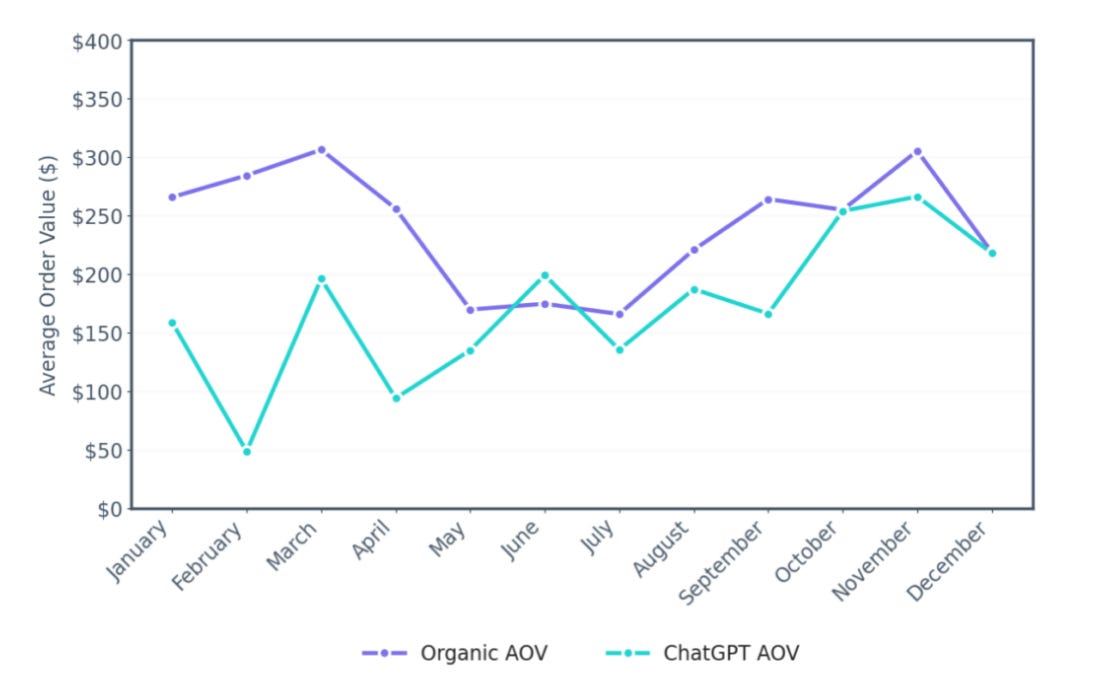
The Breakdown:
1. ChatGPT converts higher than organic search - ChatGPT drove 135,000 sessions across 94 ecommerce sites in 2025, roughly 70x smaller than non-branded organic. Revenue share sat at just 1.48% of organic, rising to 2.2% in the second half of 2025.
2. Traffic grew fast but volume stays small - ChatGPT visits grew 1,079% across 2025, from 1,544 in January to 18,202 in December. Growth was tied to shopping carousel features launched in April, though momentum began slowing around August.
3. Revenue per session beats organic, but AOV lags - ChatGPT converted at 1.81% versus 1.39% for non-branded organic, a 31% advantage. Users arrive having already narrowed their choices, making them closer to purchase than a typical search visitor.
4. Ads are now live inside ChatGPT - ChatGPT is now serving ads from brands like Best Buy, AT&T, and Expedia. Most placements fire on the first prompt, with high-intent words like “best” and “new” acting as key commercial triggers.
From emerging channel to strategic signal, GA4 likely undercounts ChatGPT’s real influence; many users research there, then buy through branded Google search. Run post-purchase surveys to close the attribution gap and get a clearer picture of AI-driven revenue.
🗝️ Tweet of the Day

🪩Events
🚀 Ever Wonder Why Some Brands Never Run Out of Winning Ideas?
Starts March 17 | Tuesdays at 1 PM EST | Virtual Bootcamp
They aren’t “more creative.” They use an internal idea-generation system that produces high-leverage angles on demand. Motion’s free 8-week program teaches that system step-by-step, live, the same one operators at Calm, Harry’s, and Happy Mammoth use daily. This is the closest thing to joining their team.
🤖 From AI Hype to Board-Level Results
March 5 | 11 AM - 6 PM ET | Virtual Event
If AI can’t show up in real numbers, it won’t survive 2026. At the AI:ROI Conference, DJ Sampath, SVP of AI Software and Platform at Cisco, joins Brice Challamel of OpenAI to share how leaders tie AI directly to adoption, efficiency gains, and margin growth.
Advertise with Us
Wanna put out your message in front of over 50,000 best marketers and decision makers?
Checkout our Partner Kit here🤝
At Buyology, we care about our readers and want to provide the best possible experience. That's why we always look for ways to improve our content and connect with our audience. It would be amazing if you could hit us up with feedback about our content or absolutely anything, we are always up for a chat 🥰
Thanks for your support, We'll be back with more such content 🥳