
Howdy Readers 🥰
In this newsletter, you’ll find:
😤 Stop Writing SEO Content Like This
🛍️ Google Just Gave Retailers Two New Tools to Win Customers They Have Never Reached Before
👨💻 Tweet of the Day
If you’re new to Buyology then a hearty welcome to you, You’ve reached the right place alongside 50k+ amazing people, Before you forget, if someone forwarded this newsletter to you, don't forget to subscribe to our newsletter so you never miss out!
😤 Stop Writing SEO Content Like This
Every SEO “Expert” says: Pick 3-5 core topics and dominate them first. The advice is right for Google. It’s incomplete for AI engines. Google determines topic authority through internal linking, backlinks, and content depth on your own domain.
AI engines determine topic authority through off-site mention density, comparative content frequency, and citation patterns across third-party sources. The same topic you’ve worked years to dominate in Google can be invisible in AI engines.
Audit Your Topic Authority On Each Surface Separately, Not As One Number
Pull your top 3 core topics and audit each against both surfaces independently.
For Google: rankings, traffic, backlink profile, and internal linking density. For AI engines: citation share across ChatGPT, Perplexity, and Claude, mention density on off-site sources, and presence in comparative content across the category.
Most brands find that their Google authority is strong while their AI engine authority is weak.
Build The Off-Site Signal Stack That AI Engines Read As Topic Authority
Google rewards the authority you build on your own domain. AI engines reward authority that exists across the web.
The signals: forum and community presence, third-party comparison content that mentions you, podcast appearances with indexed transcripts, review aggregators, and Reddit threads that surface your brand naturally.
Building this stack manually is the patchwork approach. The brands moving past it have systematized off-site signal generation as a playbook that runs without daily attention. On June 11, growth leaders from Chime, Bitly, and Udemy are walking through what they’ve built and what’s moving the needle. You can secure your free spot here.
Restructure Topic Clusters For AI Query Patterns
Google authority compounds through hub-and-spoke topic clusters. AI engine authority compounds through query-pattern coverage.
The patterns AI engines respond to: comparison content (”X vs Y for Z scenario”), use-case content (”best X for Y outcome”), and definitional content (”what is X”). A topic cluster built only around long-tail keyword variants misses these patterns.
The clusters need both layers. Long-tail keyword content for Google, query-pattern content for AI engines.
Topic authority isn’t one metric. It’s two metrics on two surfaces.
Together with Pounce
Your ads are being mislabeled. And you’d never know.

When AI mislabels your creative, it reads a humor angle as emotional, a gameplay hook as a tutorial. Your analytics treats those as real signals. Everything built on top is off.
Wrong patterns. Wrong briefs. The budget behind ads that were never working.
Pounce uses real human judgment baked into every label. 98.5% accuracy on the April 2026 Mobile Gaming Video Ads Understanding Benchmark, versus 76.9% for the best frontier model.
From there, Pounce runs your creative strategy, brief generation, competitor intelligence, and performance optimization autonomously. The work a full performance team does, without the headcount.
This intelligence was built for Supercell, Wildlife Studios, and DeNA. Studios. 4 in 5 ads beat control, and it takes 80% less time on creative research.
Pounce is the first time that the same system is available to any brand that runs ads.
Get started for free with Pounce today.
🛍️ Google Just Gave Retailers Two New Tools to Win Customers They Have Never Reached Before
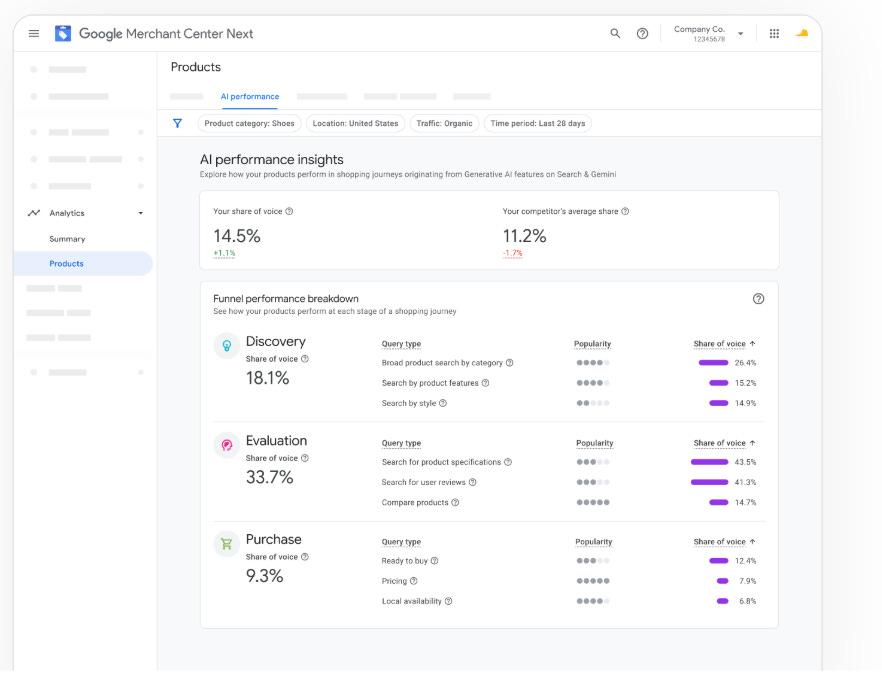
Google quietly dropped two updates this week that change how brands get found and how they find new customers. One gives retailers a window into how AI is surfacing their products. The other helps brands reach people who have never seen their name before.
The Breakdown:
Merchant Center Gets AI Shopping Insights - Four new reports are coming, covering share of voice, funnel performance, conversational queries, and missing product attributes. Retailers can now see exactly where their feeds lose discoverability inside AI results.
Incomplete Attributes Are Now a Visibility Problem - Google will flag missing specs like color, material, and style inside Merchant Center. In conversational AI shopping, incomplete product data means your products simply will not surface for the right queries.
New Prospects Mode Targets Brand-Unaware Audiences - Unlike standard new customer targeting, this mode excludes anyone who has purchased, searched your brand, visited your site, or engaged with your content across Google and YouTube.
Valuing New Customers Higher Improves ROAS - Brands using New Customer Acquisition Value Mode and valuing new buyers at twice the average order value already saw a 9% ROAS improvement in early testing.
Merchant Center is quietly evolving from a feed management tool into an AI commerce optimization platform. Retailers who treat product data with the same rigor as SEO content will have a clear edge as AI shopping expands.
🗝️ Tweet of the Day

Advertise with Us
Wanna put out your message in front of over 50,000 best marketers and decision makers?
Checkout our Partner Kit here🤝
At Buyology, we care about our readers and want to provide the best possible experience. That's why we always look for ways to improve our content and connect with our audience. It would be amazing if you could hit us up with feedback about our content or absolutely anything, we are always up for a chat 🥰
Thanks for your support, We'll be back with more such content 🥳