
Howdy Readers 🥰
In this newsletter, you’ll find:
🔐 Stop pushing compliance to later
📺 Google Adds a Budget Floor for Demand Gen and Opens Non-Skippable CTV Ads
💃Tweet of the Day
If you’re new to Buyology then a hearty welcome to you, You’ve reached the right place alongside 50k+ amazing people, Before you forget, if someone forwarded this newsletter to you, don't forget to subscribe to our newsletter so you never miss out!
🔐 Stop pushing compliance to later
Nobody warns you about the moment when growth stops being a marketing problem. You find out when a retail buyer asks for your SOC 2, and you have to Google what that means.
Product fits. Economics work. Sales motion is solid. But the channels that got you to $1M aren’t the ones that get you to $5M. At some point, growth stops coming from paid social and starts coming from relationships, wholesale accounts, enterprise integrations, and retail buyers.
Every one of those relationships has a procurement function sitting upstream of the decision-maker. That function has a checklist. If you can’t clear it, the deal doesn’t close, regardless of how good the product is.
Three moves that unlock the next tier
Start before you need it. The worst time to begin a SOC 2 audit is when a deal is on the table. Founders who close enterprise accounts typically started six to twelve months earlier. Everyone knows this. Almost nobody does it.
Know your stack before the questionnaire arrives. Enterprise buyers ask specific questions about admin access, credential rotation, and incident response. If you’re hunting for answers in real time, you fail the vibe check even if the answers are correct.
This is where Delve removes the bottleneck. It auto-collects evidence from AWS, GitHub, and your existing stack, so when a questionnaire lands, the answers are already there. Bland got compliant and hit $500k ARR in seven days. That’s not a compliance story. That’s a sales story.
You can book a free demo, trigger a migration, and get $2,000 sent to your inbox once onboarded.
Then use compliance as a sales asset. Put SOC 2 in the pitch deck, the partnership proposal, and the sales page. It ends conversations that would otherwise drag on for weeks.
The cost of waiting is invisible until it isn’t
There’s no alarm when a deal dies because a vendor questionnaire sat unanswered. No dashboard showing the enterprise account that disqualified you before you knew you were being evaluated.
It shows up later. A Series A diligence checklist. A retailer’s IT team is flagging your data handling at the 90% mark.
By the time compliance feels urgent, it’s already expensive.
Run a stack audit this quarter. Map the deals you want closed in the next twelve months and work backwards from what each one requires.
The brands that own the next revenue tier aren’t always the ones with the best product. They’re the ones a procurement manager can say yes to without escalating.
That’s the unlock.
Together with Modash
📊 Most Affiliate Programs Fail Because Brands Skip These Steps

You set commission rates. You recruit a few creators. You wait for sales to roll in. They don’t.
Affiliate marketing isn’t passive revenue. It’s a growth channel that only works when the structure behind it is built correctly.
Most brands treat it like a side experiment. The successful ones design it to compound.
Modash just published the complete A-Z guide to building an affiliate program that won’t flop.
Inside, you’ll learn:
How to set commission and discount rates using real AOV and margin math
How to recruit affiliates who drive repeat revenue, not one-off spikes
How to structure tiers, codes, and tracking so attribution and motivation hold
It includes real commission benchmarks by industry and step-by-step frameworks used by 7 and 8-figure brands.
If you’re building affiliate as a real growth channel in 2026?
📺 Google Adds a Budget Floor for Demand Gen and Opens Non-Skippable CTV Ads
Two Google Ads updates worth knowing. Demand Gen campaigns now have a minimum spend requirement, and non-skippable YouTube CTV ads are live globally with AI-managed format delivery.
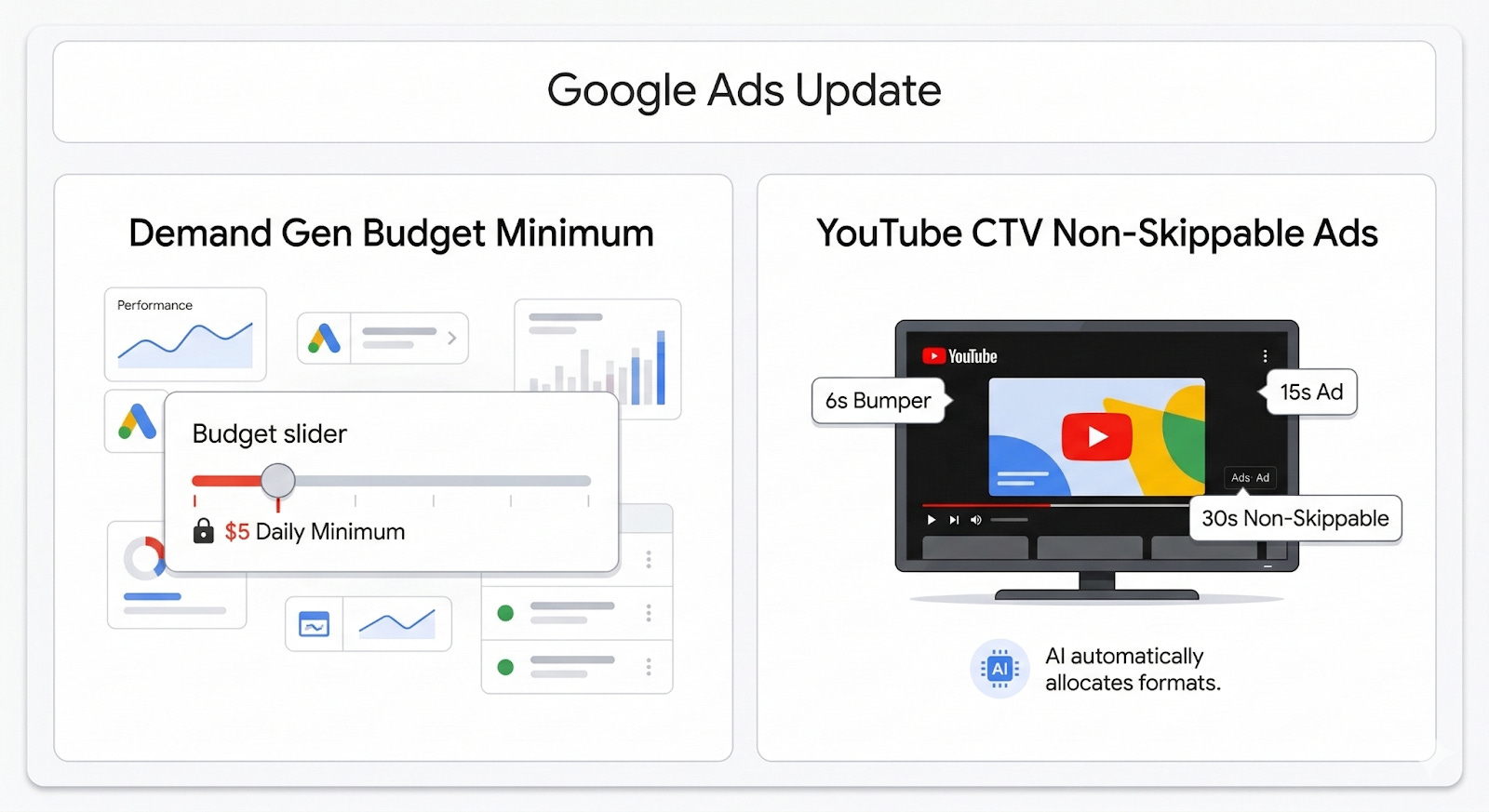
Demand Gen Gets a $5 Daily Minimum Budget - Starting April 1, the Google Ads API will enforce a $5 USD daily floor for all Demand Gen campaigns. The goal is to give Google’s models enough spending to clear the learning phase and optimize properly.
Existing Campaigns Are Safe, Until You Edit Them - Campaigns already running below $5 will keep serving. But any changes to budgets, start dates, or end dates will trigger the new minimum. API v21+ returns a specific error, v20 gives a generic one.
Non-Skippable YouTube CTV Ads Are Now Global - VRC Non-Skip ads are live in Google Ads and DV360, built for connected TV screens. Google AI manages the format mix across 6-second bumpers, 15-second spots, and 30-second non-skippable placements automatically.
Why CTV Matters Now - YouTube has been the top streaming platform in the US for three consecutive years. Non-skippable CTV gives brands guaranteed full-message delivery on the biggest screen in the house without manually managing budget splits across formats.
What to do?
If you run Demand Gen, audit any campaigns spending under $5 daily before April 1, and update your API error handling. For CTV, test VRC Non-Skip if brand awareness or upper-funnel reach is a priority. The AI-managed format allocation removes a layer of manual work worth exploring.
🥳Events
📊 AI That Proves Itself
Today | 11 AM - 6 PM ET | Virtual Event
Most AI initiatives die in budget reviews. At the AI:ROI Conference, Brice Challamel, Head of AI Strategy and Adoption at OpenAI, and Diane Igoche, Director of Agentforce Governance at Salesforce, break down how enterprise teams turn AI from experimentation into measurable revenue and operational impact.
⚡ How the Best Brands Actually Build Winning Ads (Not the Version on Twitter)
Starts March 17 | Tuesdays at 1 PM EST | Virtual Bootcamp
What top brands post about creative and what they actually do are two different worlds. For the first time, Motion is teaching the real systems: the angle frameworks, hook breakdowns, concept scoring, and iteration models used by operators behind Calm, Harry’s, and Happy Mammoth. If you’ve ever wondered what’s happening backstage, this is the door in.
Can’t attend every session live? Register anyway, you will get the recordings within 24 hours.
Advertise with Us
Wanna put out your message in front of over 50,000 best marketers and decision makers?
Checkout our Partner Kit here🤝
At Buyology, we care about our readers and want to provide the best possible experience. That's why we always look for ways to improve our content and connect with our audience. It would be amazing if you could hit us up with feedback about our content or absolutely anything, we are always up for a chat 🥰
Thanks for your support, We'll be back with more such content 🥳