
Howdy Readers 🥰
In this newsletter, you’ll find:
💪Your Reviews Are Training the Machine That Decides Your Visibility
📊 Meta And Google Expand AI Ad Transparency
👨💻 Tweet of the Day
If you’re new to Buyology then a hearty welcome to you, You’ve reached the right place alongside 50k+ amazing people, Before you forget, if someone forwarded this newsletter to you, don't forget to subscribe to our newsletter so you never miss out!
💪Your Reviews Are Training the Machine That Decides Your Visibility
Every review on your listing is now doing two jobs.
The first is the one it always did: convincing the next human shopper.
The second is new and mostly unnoticed: feeding the AI layer that now sits over Amazon search, which reads review language as primary evidence about what your product is, who it serves, and when to recommend it. The second job is quietly becoming the more valuable one, and almost nobody is writing their review strategy for it.
The AI assistant answering shopper questions does not evaluate your product the way a keyword index does. Asked which product suits a specific situation, it draws on the language real buyers used: the contexts they described, the problems they said it solved, the comparisons they made.
A listing whose reviews say “great product, fast shipping” five hundred times gives the system nothing to match against a specific question. A listing whose reviews describe morning workouts, sensitive skin, small apartments, or travel with toddlers hands the system exactly the retrieval material that conversational queries require.
This reframes what a review generation strategy is for. Volume and star average still matter for the human job. For the machine job, what matters is use-case density: the range and specificity of real situations described across your review base.
You cannot script this without violating policy, but you can influence who reviews. Buyers who purchased through authentic discovery, used the product in their real lives, and write from genuine experience produce exactly the language the retrieval layer values.
That is the structural logic behind micro-influencer seeding done properly. Stack Influence matches brands with creators from a network of 11M+ who purchase on Amazon, use the product, and share authentic experiences, generating verified purchases whose downstream reviews and content carry real use-case language into the exact systems deciding AI-era visibility. Average platform ROAS sits at 5X. You can sign up this week and save 10% on your first campaign.
Read your last fifty reviews this week and count how many describe a specific use context versus generic satisfaction. That ratio is your retrieval readiness, and it is now as much a ranking asset as your keyword strategy ever was.
Together with Omnisend
150,000 brands run on Omnisend. Now their AI does too.

You’re still exporting CSVs, switching tabs, and copy-pasting numbers just to answer “what worked this week?” That’s not a workflow.
Omnisend MCP connects your ChatGPT or Claude directly to your live Omnisend account. Ask it real questions, get real answers, and act without ever leaving the conversation.
Connect the Omnisend MCP server to ChatGPT or Claude
Paste any prompt into your conversation and watch it pull from live account data
Say “now do it,” and your AI adjusts segments, builds campaigns, fixes what’s broken
Omnisend gives you a ready-made prompt library to hit the ground running. From a quick store snapshot to a full monthly executive summary, the prompts are already written for you.
150,000+ brands run on Omnisend, and they’re averaging $79 back for every $1 spent.
Switching takes zero effort since Omnisend migrates you for free within 5 days, and your bill drops up to 35%.
Connect your AI and run your first prompt today!
📊 Meta And Google Expand AI Ad Transparency
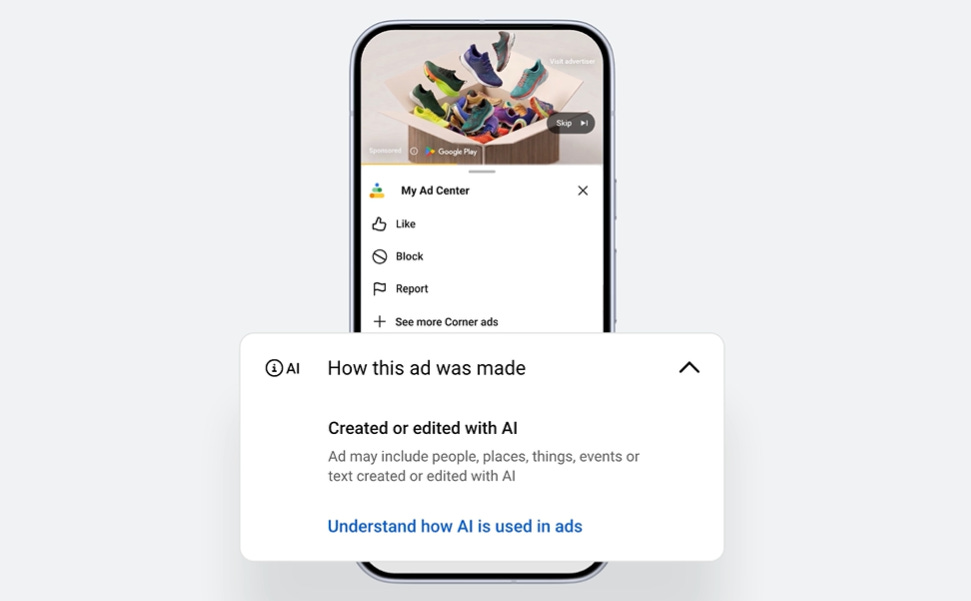
Meta and Google announced new updates for advertisers, adding better chatbot performance tracking and clearer disclosures for AI-generated advertising across their platforms.
The Breakdown:
Google Labels AI-Generated Ads - Google is introducing a new “How this ad was made” panel that tells users when generative AI was used, with disclosures added automatically for ads created using Google’s AI tools.
More Transparency For Advertisers - Google will detect AI-generated content using SynthID and C2PA metadata, while advertisers using external AI tools can also disclose AI usage through new controls.
Meta Adds Chatbot Performance Metrics - Meta Business Suite now tracks AI conversations, purchase intent, and containment rates, helping businesses measure how effectively their Messenger and WhatsApp AI agents handle customer interactions.
Better Insights For Businesses - The new reporting gives brands a clearer view of chatbot engagement and sales impact, making it easier to evaluate performance and identify where human support may still be needed.
AI is becoming a bigger part of digital advertising, but platforms are also adding ways to measure and explain its use.
The latest updates focus on helping businesses evaluate AI performance while giving users greater transparency around AI-generated content.
🗝️ Tweet of the Day

Advertise with Us
Wanna put out your message in front of over 50,000 best marketers and decision makers?
Checkout our Partner Kit here🤝
At Buyology, we care about our readers and want to provide the best possible experience. That's why we always look for ways to improve our content and connect with our audience. It would be amazing if you could hit us up with feedback about our content or absolutely anything, we are always up for a chat 🥰
Thanks for your support, We'll be back with more such content 🥳