
Howdy Readers 🥰
In this newsletter, you’ll find:
📱 Email vs SMS for the Cyber Monday Last Call: Which One Should Carry It?
🔎 Bing study of 883,000 AI citations reveals what gets referenced most
👨💻 Tweet of the day
If you’re new to Buyology then a hearty welcome to you, You’ve reached the right place alongside 50k+ amazing people, Before you forget, if someone forwarded this newsletter to you, don't forget to subscribe to our newsletter so you never miss out!
Together with Insense
Find your perfect influencers in 48hrs - who actually follow the brief!

The right UGC cuts acquisition costs in half and 4× your ad CTRs, but only if the creators follow the playbook.
Trying to manage that manually? Burnout guaranteed.
Insense gives you instant access to 115k+ niche creators in one marketplace, pre-vetted, pre-briefed, and performance-proven across 35+ countries.
Over 5000 brands use Insense to run seamless campaigns from product seeding and gifting to TikTok Shop and affiliate campaigns, and whitelisted ads.
Nurture Life cut turnaround time from 2 months to 2 weeks using just one marketer and Insense
Solawave received 180+ ad-ready assets in a single month by simply shipping products
Matys Health achieved 12× reach through Spark Ads on TikTok
Want to skip sourcing chaos and launch faster?
Book a free discovery call by December 4th and get $200 toward your first campaign.
📱 Email vs SMS for the Cyber Monday Last Call: Which One Should Carry It?
Monday evening is the last push of the year’s biggest sales window. You have one offer, a few hours, and two channels. Omnisend’s 2026 ecommerce report, built on 150,000 brands and their 2025 sends, gives the clearest side-by-side we have. Here is how they compare over five rounds.
Round 1: Conversion after the click
Email’s click-to-conversion rate rose from 5.9% to 9% globally. SMS sat at 0.97%. One caveat from the report: a fourth-quarter phone software update inflated SMS click counts, likely through bot activity, which drags that conversion rate down.
Winner: email, even allowing for the caveat.
Round 2: Revenue per send
Automated emails earned $2.87 per send against $0.74 for automated texts. For one-off campaigns, the gap nearly closes: $0.18 per email, $0.15 per text.
Winner: email for flows, close to a tie for campaigns.
Round 3: Cost per message
Each text carries a per-message fee. An extra email costs close to nothing. At even a cent or two per message, one blast to a 40,000-person list costs hundreds of dollars before anyone reads it.
Winner: email.
Round 4: Who you can reach
Your SMS list is almost certainly smaller, because texting needs its own consent. And much of this month’s growth may have come in through email only. Shoppers who commented a keyword on your Instagram sale posts and gave their address through Omnisend’s Social Capture are on your email list, ready for this send. If you haven’t switched it on yet, the Cyber Monday post is a good place to start: turn followers into email subscribers before the last call goes out.
Winner: email.
Round 5: Getting seen in time
A text lands on the lock screen. An email competes with dozens of other Cyber Monday subject lines. SMS volume grew 40% in 2025, per the same report, which suggests brands are leaning on it for exactly this. Our take: for a single deadline reminder, a text gets noticed faster.
Winner: SMS.
The verdict
Split the job. Email carries the full Cyber Monday offer to everyone, sent in the afternoon. SMS sends one short reminder around 7 PM, only to subscribers who opened or clicked the email and haven’t bought. One text, no follow-up. That keeps cost down and saves the channel’s attention for the moment it matters.
Write both tonight, while the turkey rests.
🔎 Bing study of 883,000 AI citations reveals what gets referenced most
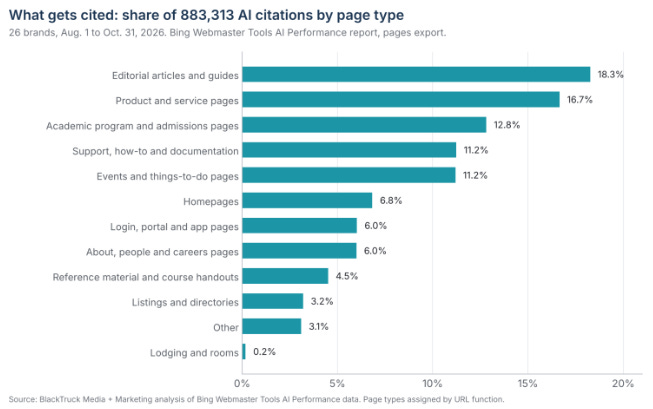
A new analysis of 883,313 AI citations across 26 brands reveals that Bing’s AI frequently references overlooked website pages, challenging traditional assumptions about which content drives AI search visibility.
The Breakdown:
Blog posts, product pages, and homepages accounted for just 42% of citations, while the remaining 58% came from support documents, app pages, staff profiles, directories, and other content.
Just over 2% of URLs generated half of all citations, showing how heavily AI relies on a small group of pages. PDFs alone accounted for over 6%, including instruction manuals and course catalogs.
Brands captured 67% of citations for branded queries but only 25% for non-branded searches, revealing significant opportunities to improve visibility when users search beyond company names.
AI-generated search queries changed rapidly, with only 37% of previously cited query strings appearing again in later data. Researchers recommend optimizing useful pages rather than chasing individual queries.
The findings suggest AI visibility extends far beyond traditional SEO content. Brands should audit their most-cited pages, including overlooked support materials and PDFs, while using Bing’s sampled reporting to identify opportunities.
🗝️ Tweet of the Day

Advertise with Us
Wanna put out your message in front of over 50,000 best marketers and decision makers?
Checkout our Partner Kit here🤝
At Buyology, we care about our readers and want to provide the best possible experience. That's why we always look for ways to improve our content and connect with our audience. It would be amazing if you could hit us up with feedback about our content or absolutely anything, we are always up for a chat 🥰
Thanks for your support, We'll be back with more such content 🥳