
Howdy Readers 🥰
In this newsletter, you’ll find:
💸 The Q4 margin leak hiding in your payout calendar
🤖 Microsoft and X push AI deeper into ad management
👨💻 Quick hits
If you’re new to Buyology then a hearty welcome to you, You’ve reached the right place alongside 50k+ amazing people, Before you forget, if someone forwarded this newsletter to you, don't forget to subscribe to our newsletter so you never miss out!
Together with Tatari
The brands winning BFCM start optimizing early.

Tatari surveyed TV advertisers about their 2026 holiday plans, and brands are moving early.
Nearly 6 in 10 are increasing their BFCM TV budgets, and 54% plan to launch holiday messaging before mid-November
Launching earlier gives brands time to find what converts before TV inventory gets more competitive and expensive.
That’s how Knix approached TV. After testing ahead of peak season, one spot drove 9,000 site visits within five minutes at a 70% lower CPA. Creative testing also doubled response rates and cut CPV by 45%.
The extra runway helped Knix identify what deserved more budget before purchase intent peaked.
By Black Friday, you don’t want to still be testing. You want to be scaling.
See how Tatari can help you scale TV for BFCM.
P.S. In NYC Oct. 29? Join Tatari at Forward for an afternoon on what’s next in advertising with Reddit CEO Steve Huffman, and marketers from Liquid IV, MANSCAPED, and more.
💸 The Q4 margin leak hiding in your payout calendar
Return fraud tactics got fresh attention this month, and the coverage focuses on the consumer side. The version that quietly costs you more is procedural, living in the gap between two calendars you probably set independently.
Affiliate and creator commissions typically pay out on a 30-day cycle. Holiday returns land at 45 to 60 days, sometimes later, because a November gift purchase does not get opened until late December and does not get returned until January. Every commission paid on an order that later reverses is margin you have already spent, on revenue that no longer exists.
Measure your actual days-to-return before you set the cycle
Do not use your published return window. Use the observed distribution.
Pull last year’s Q4 orders and plot days from purchase to return initiation. Segment gifting-heavy SKUs separately, since they skew right by weeks. Find the day by which 85% of returns have occurred. If it sits past your commission payout date, and for holiday cohorts it usually does, you are paying on unsettled revenue by design.
Replace the clawback with a holdback
Clawing money back from a creator after it has landed is the fastest way to lose a partner you spent three months recruiting.
Structure it forward instead. Pay 80% on the standard cycle and release the remaining 20% after the return window closes, with the reserve percentage set to your observed Q4 return rate rather than your annual average. Creators accept this readily when the reserve is explained as a settlement mechanic, and the release date is specific and honored.
If your return distribution stretches well past your payout cycle, the fix is not a payment rule bolted on in November. It is a recruiting calendar that gives you time to negotiate terms while creators still have room to talk, which is the logic behind Levanta’s 90-Day Holiday Sprint and its 30, 60 and 90-day checkpoints. You can download the free playbook here.
Write the fraud carve-out before peak
Standard affiliate agreements rarely distinguish an ordinary return from a coordinated one. Add three clauses before your Q4 terms lock:
A defined threshold at which a partner’s return rate triggers review rather than automatic reversal
Explicit language that reserves are released on a stated date regardless of dispute status elsewhere
A named owner on your side responsible for the release, so it does not slip into January
Terms are easy to agree when nobody knows whose commission is affected. They become a negotiation the moment the numbers are visible, which is the argument for settling them now rather than in week three of December.
🤖 Microsoft and X push AI deeper into ad management
Microsoft and X are both changing how advertisers manage campaigns with AI. Microsoft is expanding its own Search automation globally, while X is letting advertisers bring their preferred AI assistant directly into campaign workflows.
The Breakdown:
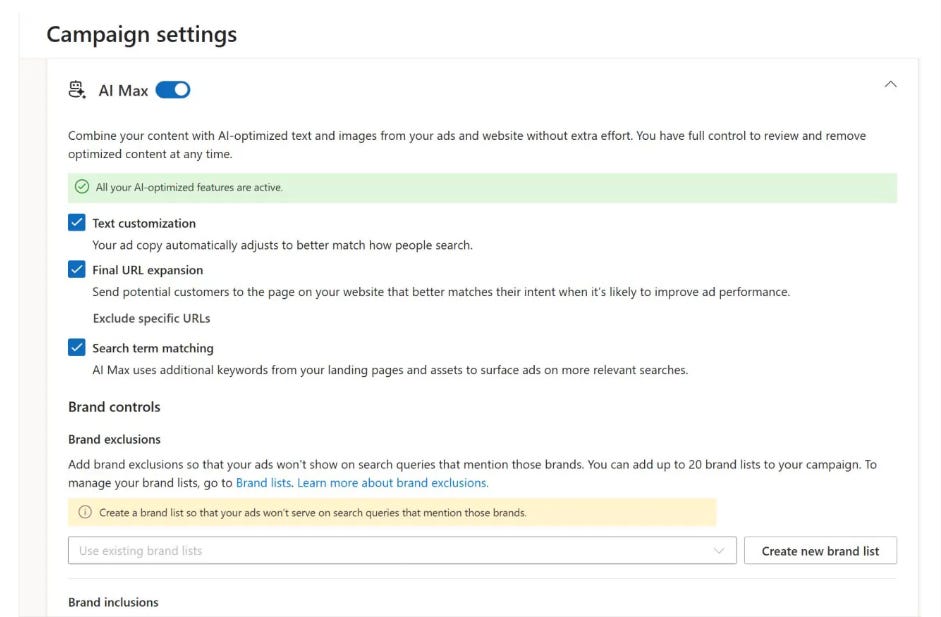
Microsoft takes AI Max global - AI Max is rolling out globally with search term matching, text customization, and final URL expansion, extending Search campaigns beyond traditional keyword targeting.
Advertisers keep more control - Microsoft includes brand inclusions and exclusions, URL rules, text-generation exclusions, and ad group-level settings, while letting advertisers test individual AI Max features through experiments.
Google imports carry AI settings - Supported AI Max settings enabled in imported Google Search campaigns will automatically carry into Microsoft Advertising, although campaigns originally upgraded from Dynamic Search Ads are handled differently.
X opens ads to outside AI - X’s new Ads MCP lets advertisers connect campaign data and analytics to MCP-compatible tools like Grok, Claude Code, or custom agents and manage them through natural-language queries.
Ad platforms are splitting into two AI strategies: build the intelligence directly into campaign management or let advertisers bring their own AI agent. Either way, manually digging through dashboards is becoming less central to the job.
🗝️ Tweet of the Day

Advertise with Us
Wanna put out your message in front of over 50,000 best marketers and decision makers?
Checkout our Partner Kit here🤝
At Buyology, we care about our readers and want to provide the best possible experience. That's why we always look for ways to improve our content and connect with our audience. It would be amazing if you could hit us up with feedback about our content or absolutely anything, we are always up for a chat 🥰
Thanks for your support, We'll be back with more such content 🥳