
Howdy Readers 🥰
In this newsletter, you’ll find:
👀 Why certain brands start occupying space in your head
📌 Snapchat unifies app measurement while Pinterest says start your Christmas campaigns now
👨💻 Tweet of the Day
If you’re new to Buyology then a hearty welcome to you, You’ve reached the right place alongside 50k+ amazing people, Before you forget, if someone forwarded this newsletter to you, don't forget to subscribe to our newsletter so you never miss out!
👀 Why Certain Brands Start Occupying Space In Your Head
A woman films herself frosting the exact same cake every Friday night. Someone else keeps asking strangers in New York absurdly specific questions about their outfits. There is a founder on your feed right now whose entire internet presence appears to consist of opening boxes with a pocket knife while breathing heavily into a microphone.
None of this should work as well as it does.
And yet after a while, your brain begins waiting for these people without formally deciding to. Not because the videos are technically brilliant. The repetition itself starts creating emotional traction.
That is the shift a lot of brands still misunderstand.
Attention online no longer behaves like a billboard economy where every impression starts from zero. Repeated formats accumulate familiarity. Familiarity changes resistance. Once resistance drops enough, the audience stops evaluating each piece of content independently and starts re-entering a world they already recognize.
That is a completely different psychological experience.
1. Predictability became valuable again
For years, creative strategy revolved around surprise. New hooks. New edits. Constant reinvention.
But highly scalable content often behaves more like ritual than novelty.
The audience begins recognizing the emotional architecture before the video fully unfolds. They know roughly how the interaction feels, which lowers processing friction dramatically. That matters because the feed is exhausting now. Familiar structures conserve attention.
A recognizable format also creates stronger memory encoding. Not because one episode was extraordinary, but because the repetition stitched the episodes together into a larger pattern the brain could retrieve later.
2. Audiences attach to behavioral texture, not polish
This is where beautifully produced brand content quietly dies. People remember odd little consistencies:
the founder who pauses too long before answering
the employee who always breaks character first
the creator whose apartment lighting never changes
the recurring joke that keeps mutating every episode
Those details create psychological permanence because they feel socially real. Human memory stores texture far more aggressively than polished messaging.
After enough exposure, the audience no longer feels like they are consuming branded media. They feel like they are revisiting familiar people.
That distinction has enormous commercial consequences.
3. Episodic content usually collapses operationally before creatively
Keeping recurring creator systems alive gets chaotic fast. Rights management fragments. Approvals pile up. The same creator suddenly becomes unavailable mid-series.
Internal teams lose consistency trying to coordinate production manually across scattered workflows.
Insense helps brands sustain creator-led formats without the operational drag killing momentum underneath them, from sourcing creators and managing briefs to automated payments and lifetime usage rights. You can book a free strategy call by tomorrow and get a $200 platform credit towards your first campaign.
A one-off post can generate reach. A recognizable format can slowly become part of someone’s routine, language, memory, and even identity.
That is a far more durable growth engine than chasing the next viral spike every week.
Together with Pounce
Most AI is wrong 1 in 4 times. Pounce is wrong 1 in 50.

Creative analytics tools that run on off-the-shelf AI mis-tag your ads nearly a quarter of the time. Every bad tag is a false pattern, a misleading insight, a wasted brief. Your whole performance function ends up working off bad data.
Pounce fixes it at the source with real human judgment baked into every label. 98.5% accuracy on the April 2026 Mobile Gaming Video Ads Understanding Benchmark, versus 76.9% for the best frontier model.
And accurate data is just the start. Pounce runs your creative strategy, brief generation, competitor intelligence, and performance optimization autonomously, without adding headcount.
The same intelligence behind Supercell, Wildlife Studios, and DeNA. Now available to any brand that runs ads.
Get started for free with Pounce today.
📌 Snapchat Unifies App Measurement While Pinterest Says Start Your Christmas Campaigns Now
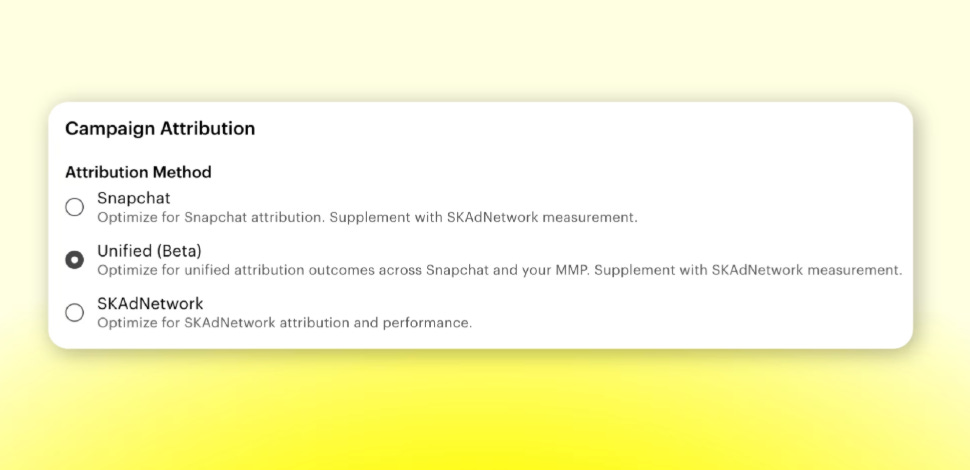
Snapchat launched unified attribution for app marketers. Pinterest is telling brands that Q4 success starts months before November. Both updates are about making ad spend smarter through better data.
The Breakdown:
Snapchat Combines All Metrics in One View - Unified Attribution merges Snap platform metrics with mobile measurement partner data, and SKAdNetwork signals into one dashboard so app marketers can see real cross-channel performance without piecing together separate reports.
It Helps Justify Snap Ad Spend - The combined view connects in-app and external response signals to show actual campaign impact, giving app developers a clearer direction on what’s working among Snapchat’s influential younger audience.
Pinterest Says Start Planning Q4 Now - 31 weeks until Christmas. Users come to Pinterest to plan months ahead, and advertisers running shopping campaigns for six months or more see 33% higher ROAS than those running under three months.
Always-On Campaigns Win on Pinterest - Performance+ catalog campaigns powered by Conversions API deliver 20% lower cost per action. Pinterest recommends 75% of the platform budget going to always-on initiatives because longer runs produce better optimisation data.
Snapchat is making it easier to prove app campaign ROI across channels. Pinterest is making the case that Q4 winners are decided in Q2. Both reward marketers who plan ahead and invest in measurement.
🗝️ Tweet of the Day

Advertise with Us
Wanna put out your message in front of over 50,000 best marketers and decision makers?
Checkout our Partner Kit here🤝
At Buyology, we care about our readers and want to provide the best possible experience. That's why we always look for ways to improve our content and connect with our audience. It would be amazing if you could hit us up with feedback about our content or absolutely anything, we are always up for a chat 🥰
Thanks for your support, We'll be back with more such content 🥳