
Howdy Readers 🥰
In this newsletter, you’ll find:
🛑The Brands That Scale Cleanly Never Wait for the Warning Signs
📈 Gemini Traffic Doubles While ChatGPT Hits $100M in Ad Revenue
🚀Quick Hits
If you’re new to Buyology then a hearty welcome to you, You’ve reached the right place alongside 50k+ amazing people, Before you forget, if someone forwarded this newsletter to you, don't forget to subscribe to our newsletter so you never miss out!
🛑The Brands That Scale Cleanly Never Wait for the Warning Signs
Most media buyers treat performance decline as the starting point for diagnosis. CPA climbs, ROAS softens, and suddenly the account is under a microscope. Creative gets refreshed. Audiences get expanded. The team moves fast to fix what broke.
The problem isn’t the response. It’s the timing. By the time the warning signs appear, the damage is already priced into the campaign. You’re now paying premium CPMs to solve a problem that was sitting in the data weeks before the budget moved.
Reactive scaling isn’t just inefficient. It’s structurally more expensive than the alternative every single time.
Every account has a ceiling. Most teams only find it one way.
That ceiling isn’t arbitrary. It’s a function of three specific variables: how many genuinely distinct creative angles are in rotation, how much addressable audience exists at the next spend tier, and how frequently the category converts at scale.
When spend outpaces any one of those variables, efficiency doesn’t taper gradually. It breaks suddenly, in a way that’s expensive to recover from mid-flight.
The ceiling was always there. The account was just running below it.
What does it actually require to find it before you hit it?
Three questions need honest answers before the budget conversation happens.
How psychologically distinct is the current creative portfolio? Not how many ads are running, how many genuinely different emotional entry points, narrative structures, and reasons to buy are represented.
Fewer than five distinct angles means frequency becomes a conversion problem within weeks of a meaningful budget increase, regardless of how strong the individual creatives are.
How does the addressable audience behave at the next spend tier? Broad audiences at $50k a month are not the same audience at $150k a month. The composition shifts, the intent signals change, and the creative that was converting efficiently starts reaching people it was never built for.
Mapping that shift before committing to spend is the difference between a planned expansion and an expensive surprise.
Where are the early stress signals already visible? CTR softening slightly. CPC creeping up on core ad sets. Frequency ticking past the point where the account historically starts showing fatigue. These are not lagging indicators.
They’re the account telling you the ceiling is closer than the headline ROAS number suggests. Most teams aren’t looking for them until it’s too late to act on them cleanly.
The audit that changes the conversation.
Galactic Fed runs exactly this kind of pre-scale diagnostic, a full channel audit, competitive breakdown, and growth plan built from real spend data across 600 plus brands. Crowd Cow grew revenue 137% and customer acquisition 122% through this process.
Real people reviewing your actual account before you get on a call. You can reserve your session. 10 spots. No cost.
Scaling spend is always a lagging decision. Creative depth, audience infrastructure, and stress signal visibility are the leading decisions that determine whether the scale holds or breaks.
The ceiling exists either way. The only variable is whether you find it on your terms or the algorithm’s.
Together with Planable
Agency Profitability Report: Benchmarks & Trends (2026)

Every agency founder runs the same mental checklist. Do we need to raise our prices? Maybe we need a bigger team? Should we just go all-in on AI?
Planable surveyed 186 SEO and Social agencies to understand which patterns are most strongly associated with profitability.
The agencies reaching 41%+ margins look structurally different:
- They’re more likely to have a broader client base. 53% of single-client agencies are losing money. Meanwhile, 53% of solo founders serving 5-10 clients are high-profit.
- They’re more likely to optimize labor. 40.8% of high-profit agencies use labor optimization as their primary lever.
- They don’t rely on AI alone. AI works very differently depending on the surrounding operational and commercial model.
Find out where you stand, what may be driving the margin gap, and which structural patterns are most closely tied to stronger margins.
📈 Gemini Traffic Doubles While ChatGPT Hits $100M in Ad Revenue
Gemini’s website referral traffic more than doubled in two months after the Gemini 3 rollout, while ChatGPT’s declined from its October peak. Meanwhile, OpenAI hit $100M in annualized ad revenue just six weeks into its ad pilot.
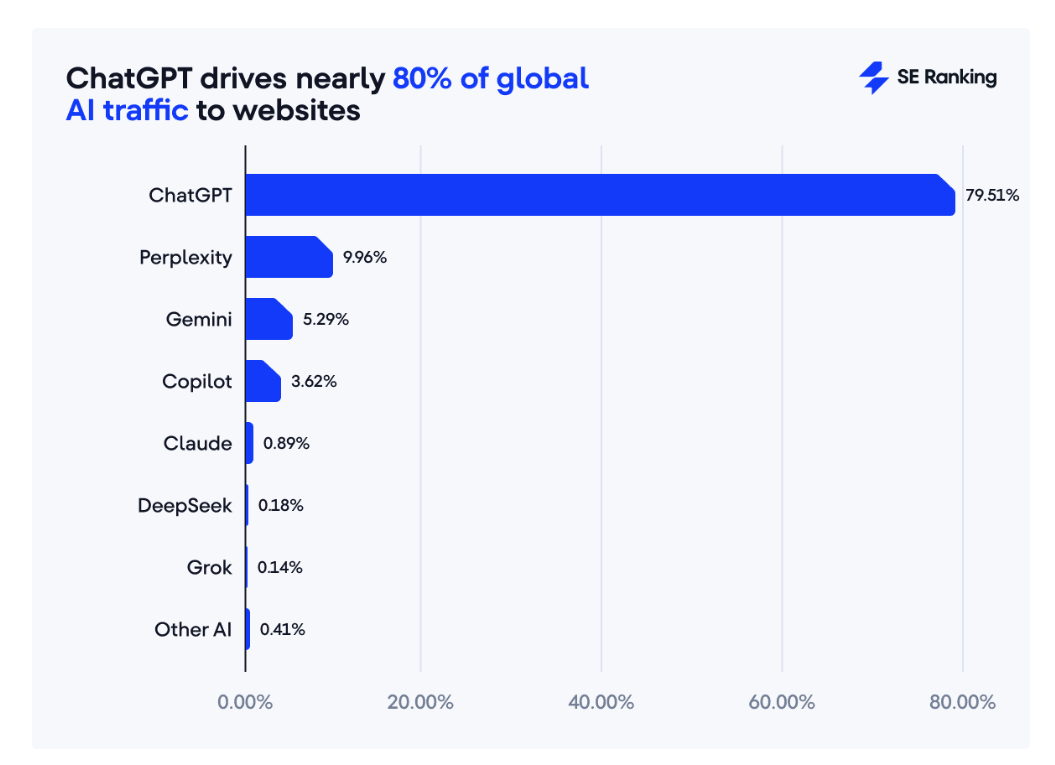
The Breakdown:
1. Gemini Traffic Surged 115% in Two Months - Website visits from Gemini grew 51.5% in December and 42% in January, timed perfectly with the Gemini 3 model rollout across Google’s ecosystem, and Gemini has now overtaken Perplexity as a referral source globally.
2. ChatGPT Traffic Dropped While It Still Dominates - ChatGPT fell 22% from its October peak but still sends 8x more traffic than Gemini, down from 22x three months ago, and nearly 4 out of 5 AI visits to websites still come from ChatGPT.
3. ChatGPT Ads Hit $100M With Most Users Still Unseen - OpenAI reached $100M in annualized ad revenue with less than 20% of eligible users seeing ads and over 600 advertisers on the platform, with self-serve access launching in April and expansion into Canada, Australia, and New Zealand planned.
4. Ad Quality Is Holding Up So Far - Fewer than 7% of ChatGPT ads are rated “low relevance” by users, a metric OpenAI says it is actively working to improve alongside user trust ahead of its anticipated IPO.
Don’t build your AI visibility strategy around one platform. Track referral traffic from ChatGPT, Gemini, and Perplexity separately. ChatGPT’s ad self-serve in April is the moment this becomes accessible to everyone, and getting in early before costs rise is the same playbook that rewarded early movers in search and social.
🗝️ Tweet of the Day

Advertise with Us
Wanna put out your message in front of over 50,000 best marketers and decision makers?
Checkout our Partner Kit here🤝
At Buyology, we care about our readers and want to provide the best possible experience. That's why we always look for ways to improve our content and connect with our audience. It would be amazing if you could hit us up with feedback about our content or absolutely anything, we are always up for a chat 🥰
Thanks for your support, We'll be back with more such content 🥳