
Howdy Readers 🥰
In this newsletter, you’ll find:
🥺Your Discount Logic Is Punishing the Customers Who Earned It
📊 ChatGPT Ads Are Moving From Experiment to Platform This Week
👨💻 Quick Hits
If you’re new to Buyology then a hearty welcome to you, You’ve reached the right place alongside 50k+ amazing people, Before you forget, if someone forwarded this newsletter to you, don't forget to subscribe to our newsletter so you never miss out!
🥺Your Discount Logic Is Punishing the Customers Who Earned It
Most discount conflicts don’t look like technical errors. They look like price increases that appear from nowhere at checkout. The customer blames the brand. The brand blames price sensitivity.
The real cause is discount architecture never stress-tested against real cart behaviour, usually because the threshold and the codes were built by different people, months apart, and never run together.
The threshold collision that turns rewards into penalties. Free shipping thresholds and discount codes are almost never tested in combination. So when a customer qualifies for free shipping, applies a discount code, and drops below the threshold, shipping reappears. The code they earned just cost them more than it saved.
That exit reads as price sensitivity in your data. It’s a structural gap between two systems that were never introduced to each other.
The bundle discount that has no awareness of intent. Bundle logic is built around SKU configuration, not cart state. When a customer modifies a bundle, the system checks the product list, finds a mismatch, and reverts the discount. The result:
The cart total jumps in a way they can’t reverse-engineer
There’s no UI that explains what changed or why
The store doesn’t look expensive. It looks broken.
Customers don’t abandon broken carts slowly.
Checkout Index benchmarks your store against 500+ brands and surfaces exactly these structural conflicts before they cost you another order. Enter your URL and get a personalised score in 60 seconds. No install. No demo call. See Your Score.
The stacking conflict the customer can never see coming. When a loyalty credit, welcome code, and seasonal auto-discount sit in the same cart, your priority logic fires them in a sequence the customer has no visibility into. One cancels another. The final total doesn’t match what any individual offer promised. They do the maths, find the gap, and with no explanation available, draw the only conclusion they can:
The store adjusted the numbers quietly
The discount wasn’t real
They’re not coming back
No standard checkout UI shows a line item that reads “discount cancelled due to stacking rules.” That transparency gap is what kills trust, not the discount logic itself.
Together with Insense
You know UGC works for you. Now build the machine.

You know creator content works for your brand. The challenge now isn’t whether to do it; it’s how to do it at volume without the process falling apart.
Insense is the self-serve platform for DTC brands that have outgrown manual UGC.
Source from 80,000+ vetted creators, run multiple campaigns in parallel, automate contracts and payments via Shopify integration, and receive content in 14 days, with full lifetime usage rights included.
Trusted by SmileSet, Paysend, Bending Spoons, Quince, Monster Energy, and 3,500+ brands using Insense to turn what works into a repeatable production system.
Book a free strategy call by May 15 and get a $200 platform credit towards your first campaign.
📊 ChatGPT Ads Are Moving From Experiment to Platform This Week
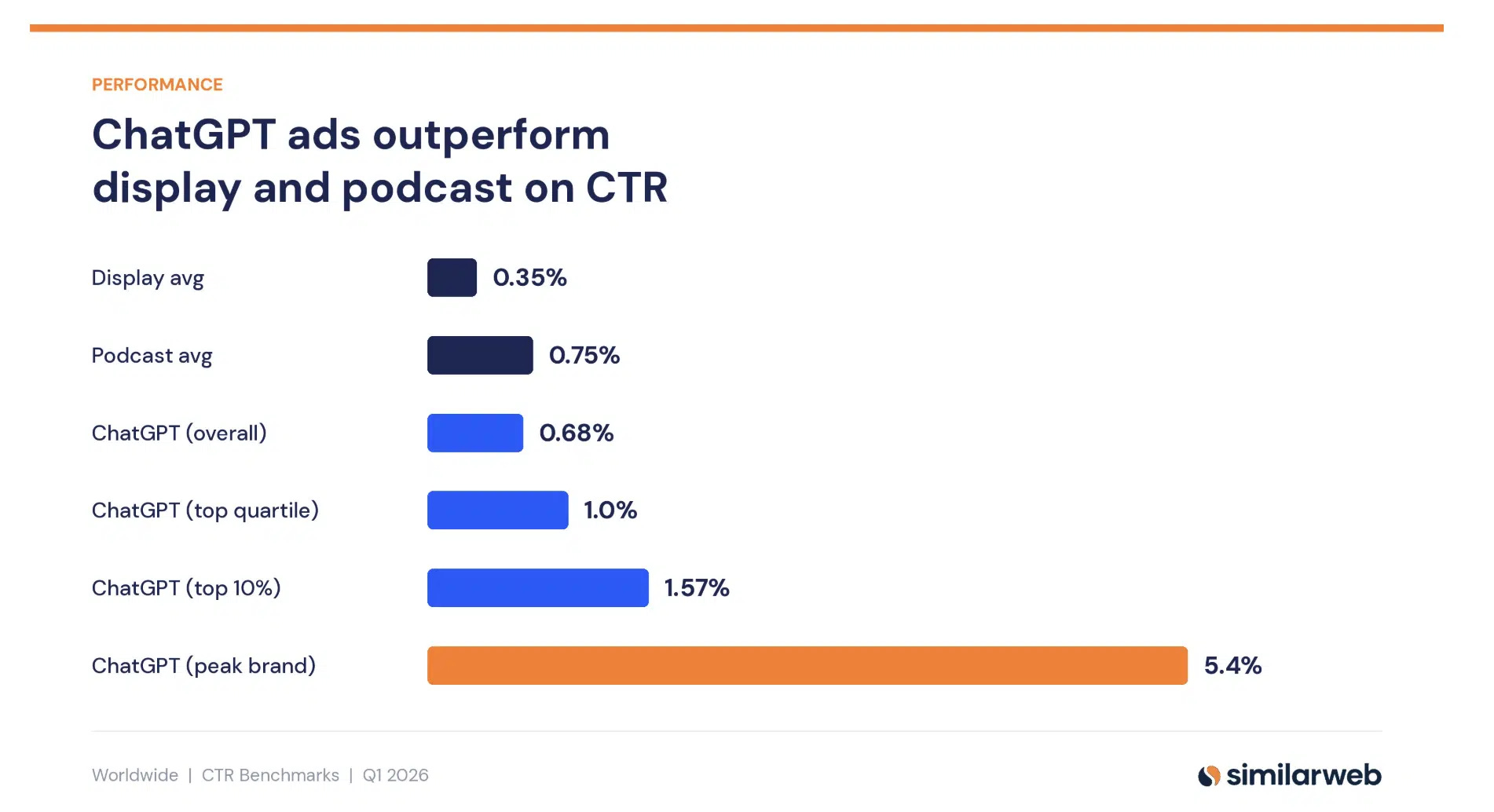
Early CTR data shows ChatGPT ads outperforming traditional benchmarks while OpenAI launched self-serve buying, CPC bidding, and pixel-based measurement, a clear shift from a limited test to a full ad platform.
The Breakdown:
Early CTRs Impress - SimilarWeb data shows ChatGPT ads generating strong CTRs versus display and podcast channels. Mother’s Day prompts trigger ads three times more than average due to high purchase intent.
Scale Remains Uncertain - Inventory is still limited, and early performance often looks better before wider rollout. The novelty factor may be inflating engagement; conversion quality will ultimately determine whether this channel is real.
Self-Serve Is Now Live - OpenAI launched a beta Ads Manager in the US, giving advertisers direct control over budgeting, bidding, and creative uploads. CPC bidding is now available alongside CPM.
Measurement Finally Catches Up - Pixel-based tracking and a Conversions API let advertisers measure purchases, sign-ups, and leads. Data is aggregated with no access to individual conversations, reinforcing OpenAI’s privacy focus throughout.
ChatGPT ads are following a familiar platform playbook, high-touch partner-led launch followed by self-serve tools that unlock scale. WPP, Publicis Groupe, Criteo, and Adobe are already in the partner network. Conversion data at volume is what will make or break this.
🗝️ Tweet of the Day

Advertise with Us
Wanna put out your message in front of over 50,000 best marketers and decision makers?
Checkout our Partner Kit here🤝
At Buyology, we care about our readers and want to provide the best possible experience. That's why we always look for ways to improve our content and connect with our audience. It would be amazing if you could hit us up with feedback about our content or absolutely anything, we are always up for a chat 🥰
Thanks for your support, We'll be back with more such content 🥳