
Howdy Readers 🥰
In this newsletter, you’ll find:
🎯Choose your target wisely
🤖 Google Brings More Visibility to Performance Max
👨💻 Tweet of the Day
If you’re new to Buyology then a hearty welcome to you, You’ve reached the right place alongside 50k+ amazing people, Before you forget, if someone forwarded this newsletter to you, don't forget to subscribe to our newsletter so you never miss out!
🎯Choose your target wisely
Amazon Marketing Cloud’s latest update looks like another targeting feature.
It isn’t.
For the first time, AMC custom audiences and lookalikes can be activated inside Sponsored Products, the campaign type where most Amazon brands spend the majority of their ad budget.
That changes one important question.
You’re no longer deciding who to target. You’re deciding which customers teach Amazon who to target next.
Every customer in your seed audience becomes training data. The quality of tomorrow’s targeting depends on the quality of the customers you let into that dataset.
Stop feeding the algorithm every purchase.
A purchase proves someone converted.
It doesn’t prove they’re the customer you want more of.
A discount hunter who never returns teaches Amazon something very different from someone who buys at full price, leaves a detailed review, reorders and never requests a refund.
Instead of building audiences from all purchasers, build them from customers who demonstrate conviction after the sale. Repeat purchases, thoughtful reviews and meaningful post-purchase engagement are stronger predictors of future high-value customers than the purchase itself.
Solve the real bottleneck.
The challenge isn’t building an AMC lookalike.
It’s creating a large enough pool of high-conviction customers to build one from.
Most brands wait months for enough detailed reviews and engaged buyers to accumulate naturally. That means their targeting model is learning from weak signals for far longer than necessary.
This is where Stack Influence changes the equation. Instead of hoping enough ideal customers appear over time, creators purchase your product on Amazon, genuinely use it, leave detailed experience-based reviews and create original content. You’re not just generating reviews.
You’re accelerating the exact behavioral signals AMC uses to identify and find more customers like them. Every campaign strengthens the training data behind your highest-spending Sponsored Products campaigns, creating value long after the creator campaign ends.
Before your next Sponsored Products budget cycle, build the audience Amazon actually deserves to learn from. You can sign up in the next two weeks and take 10% off your first campaign.
Keep raising the bar.
As your catalog grows, become more selective about who enters the seed.
Better algorithms don’t come from more customer data. They come from better customer examples.
The brands that win with AMC won’t have the biggest audiences. They’ll have the best teachers.
Together with Billo
Half of the top UGC ads share 3 hook types. Most marketers skip all of them.

Billo analyzed every top-performing creator ad on the platform and tagged each one by hook type. The hooks most marketers default to - list formats, FOMO framing, comparison setups, and insider angles barely showed up at the top.
The three that won are in the full breakdown, with the exact lines those ads opened with.
Read it before your next round of creator ads.
🤖 Google Brings More Visibility to Performance Max
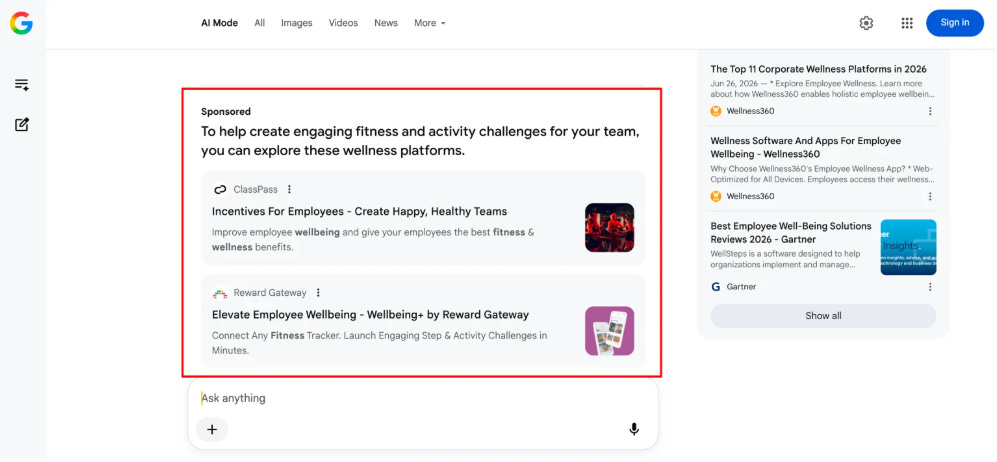
Google is expanding both AI-powered advertising and campaign reporting, with AI Mode showing ads on more searches while Performance Max now reports product data across all eligible networks.
The Breakdown:
AI Mode Ad Growth - Google AI Mode displayed text ads on 29.45% of commercial queries in SE Ranking’s study, with keywords costing $10+ CPC showing ads on 53.56% of searches.
Ads Don’t Boost Visibility - Buying AI Mode ads did not improve AI citations or organic rankings. Only 11.53% of advertiser domains appeared as cited sources, while about 85% didn’t rank organically for the same queries.
PMax Reporting Expands - Google expanded Performance Max product reporting to include all eligible networks, including Search, Video, App, and Demand Gen campaigns, providing a broader view of product performance.
Reporting Metrics Shift - Advertisers may notice sudden increases in impressions, clicks, conversions, and other metrics, but Google says these reflect expanded reporting coverage rather than improved campaign performance.
Google is separating AI advertising, AI visibility, and organic search into distinct channels while giving advertisers more comprehensive measurement across its ad ecosystem. Brands should evaluate reporting changes carefully and avoid comparing new Performance Max data directly with historical results.
🗝️ Tweet of the Day

Advertise with Us
Wanna put out your message in front of over 50,000 best marketers and decision makers?
Checkout our Partner Kit here🤝
At Buyology, we care about our readers and want to provide the best possible experience. That's why we always look for ways to improve our content and connect with our audience. It would be amazing if you could hit us up with feedback about our content or absolutely anything, we are always up for a chat 🥰
Thanks for your support, We'll be back with more such content 🥳