
Howdy Readers 🥰
In this newsletter, you’ll find:
😤The Myth: Everyone Gets 20% Off for BFCM. The Reality: You’re Overpaying Half Your List.
🤖 AI Ads Expand Across Platforms
👨💻 Tweet of the Day
If you’re new to Buyology then a hearty welcome to you, You’ve reached the right place alongside 50k+ amazing people, Before you forget, if someone forwarded this newsletter to you, don't forget to subscribe to our newsletter so you never miss out!
😤The Myth: Everyone Gets 20% Off for BFCM. The Reality: You’re Overpaying Half Your List.
The myth every DTC founder repeats going into Q4: blanket discounting is simple, fair, and easiest to execute under deadline pressure. One code, one banner, one email. Every customer gets the same 20% off.
The reality sitting in the order history: a real share of any list converts on free shipping alone with zero percentage discount needed, another share only moves with a meaningful percentage on the table, and a third segment buys regardless of any offer at all. Blanket discounting overpays the first and third groups and possibly still underpays the second.
Segment by historical offer response, not purchase recency. Export the last four promotional sends and tag which customers converted on shipping-only offers versus percentage offers versus no offer at all. Three genuinely different incentive needs, currently getting one identical email.
Build a time-decay discount ladder instead of one flat code for the whole window. Open the sale with free shipping only for the first two days, escalate to a modest percentage by day four, and reserve the full 20% for the final 24 hours only. High-intent early browsers convert without needing the deepest discount, and the price-sensitive segment still gets moved before the window closes, without every customer defaulting straight to the maximum incentive from hour one.
Match discount depth to inventory position, not to a blanket revenue target. Full-price hero SKUs get a gift-with-purchase or bundle instead of a percentage off, protecting margin on what’s already selling well. Slow-moving inventory gets the real percentage discount, since that’s the stock actually needing a push to clear before the next season’s drop.
Running all three by hand means cross-referencing order history against past offers and current inventory position manually, product line by product line, under exactly the deadline pressure that makes teams default to the easy flat code instead.
Connect Omnisend to Claude or ChatGPT and say “build it”: your AI creates each of these three segments directly from live revenue and campaign data, ready to review. You can get started with ready-made prompts
Founders defending margin during the highest-spend quarter of the year are the ones this actually protects. The flat 20% code is the easy plan. It’s also the expensive one, and the gap between the two only shows up in the P&L after the season’s already over.
Together with AirOps
Why are your top pages still missing AI’s pipeline

Traffic from AI search is growing, but most teams haven’t figured out how to turn it into a pipeline. Comparison pages, pricing pages, and feature pages either aren’t getting cited or aren’t converting when they are.
On August 5 at 2pm ET, Josh Grant, founder of StackedGTM and former VP of Growth at Webflow, joins AirOps’ Josh Spilker for a tactical session on the plays that turn AEO into revenue this quarter.
You’ll walk away with:
Why comparison pages are one of the fastest ways to capture mid-funnel AI search demand
What makes pricing and feature pages more extractable for models to cite and summarize accurately
How third-party corroboration from sites like G2, Capterra, and Reddit strengthens on-site messaging
Audit your feature pages against Josh’s AEO framework live, and leave with a ranked fix-it list
Can’t make it live? Register anyway and get the recording in your inbox within 24 hours.
🤖 AI Ads Expand Across Platforms
AI assistants are evolving into advertising platforms, while new research suggests brands will need different strategies for paid placements, AI citations, and audience reach.
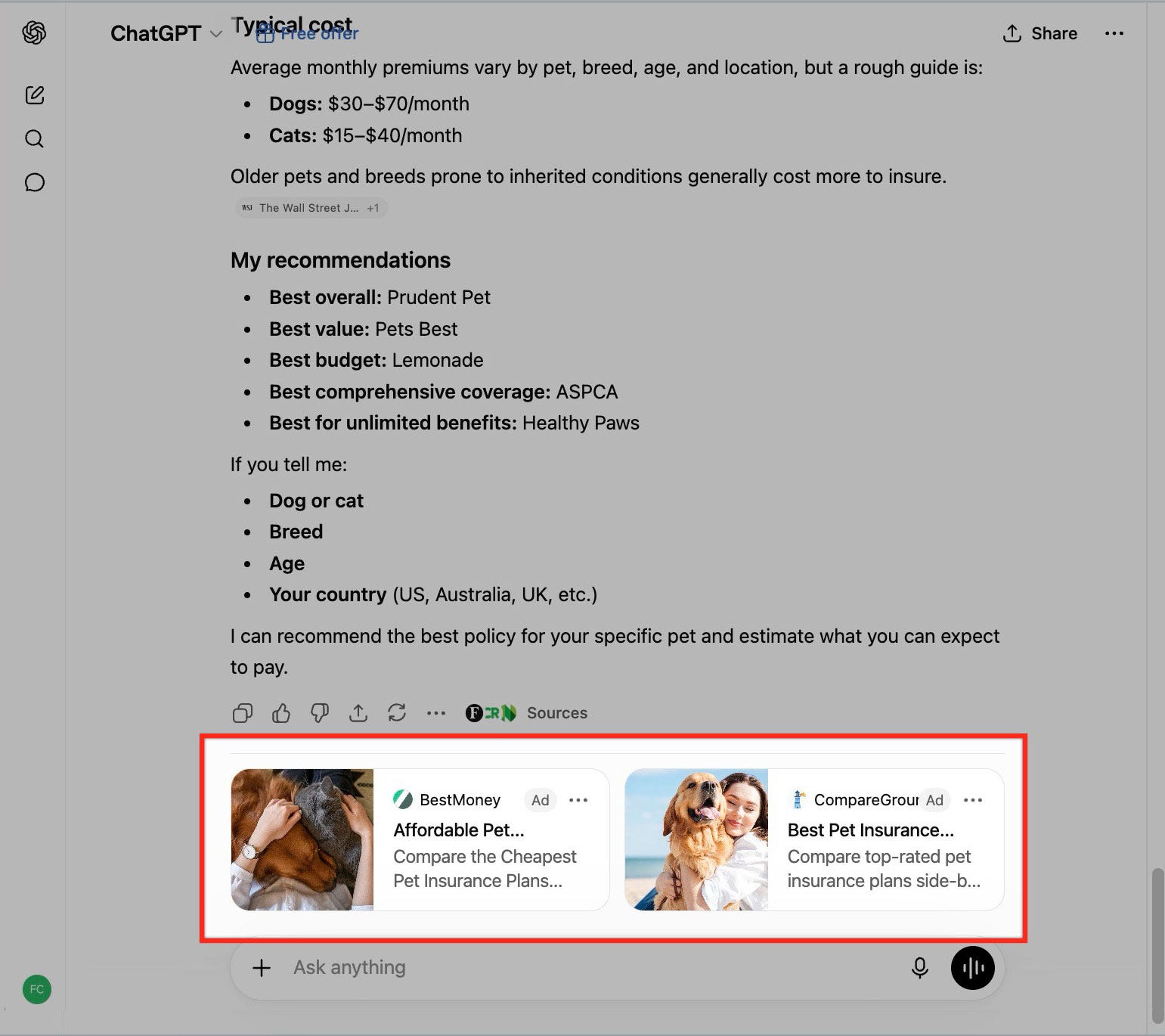
The Breakdown:
ChatGPT Opens More Ad Space - OpenAI is expanding ChatGPT’s advertising tests by showing two ads from different advertisers within a single response, signaling a broader rollout of ad inventory inside the chatbot.
Google Treats Ads And Citations Differently - A recent study found Google AI Mode displayed ads on 29% of commercial searches, but advertisers were cited by the AI only 11% of the time, meaning paid placements don’t automatically influence AI recommendations.
Expensive Keywords See More Ads - Google AI Mode was far more likely to show ads on high-CPC searches, with ad visibility climbing to 53.56% for keywords costing more than $10 per click, while search volume had little effect.
AI Users Are Spreading Out - ChatGPT’s share of AI users has slipped below 50% as Gemini and Claude continue gaining users, making it harder for brands to rely on a single AI platform for reach.
AI is becoming a multi-platform advertising ecosystem. As paid placements, AI citations, and user attention increasingly operate independently, marketers will need to optimize each instead of relying on a single visibility strategy.
🗝️ Tweet of the Day

Advertise with Us
Wanna put out your message in front of over 50,000 best marketers and decision makers?
Checkout our Partner Kit here🤝
At Buyology, we care about our readers and want to provide the best possible experience. That's why we always look for ways to improve our content and connect with our audience. It would be amazing if you could hit us up with feedback about our content or absolutely anything, we are always up for a chat 🥰
Thanks for your support, We'll be back with more such content 🥳