
Howdy Readers 🥰
In this newsletter, you’ll find:
⚠️ Are Creators Hurting Your Reach
🧠 LinkedIn Research Redefines B2B Trust
🚀Tweet of the Day
If you’re new to Buyology then a hearty welcome to you, You’ve reached the right place alongside 50k+ amazing people, Before you forget, if someone forwarded this newsletter to you, don't forget to subscribe to our newsletter so you never miss out!
⚠️Are Creators Hurting Your Reach
Creator consolidation is usually framed as an efficiency move. Fewer campaigns, stronger signals, faster learning.
That framing is incomplete.
The real question is not whether consolidation improves performance. It’s what kind of performance it improves. Consolidation reliably improves certainty. It does not reliably improve coverage.
Once you see that distinction, the rules become obvious.
Rule 1: Consolidate when creators attract the same buyer logic.
If multiple creators speak to the same motivation, same usage context, and same identity frame, consolidation helps.
Meta can treat creator variation as a creative variable while learning against one buyer profile. This is where you get faster optimization and cleaner spend distribution.
Rule 2: Separate when creators act as audience shortcuts.
Some creators don’t just explain the product; they imply who the product is “for.” When that implication changes the buyer’s self-perception or use case, Meta needs clean learning. If you consolidate here, the platform will default to the creator with the strongest historical overlap and suppress exploration into other audiences.
This is why some teams rely on managed creator and publisher whitelisting partners like Grapevine to test new archetypes cleanly without operational drag. You can book a strategy call by February 27th for $500 off your first campaign.
Rule 3: Watch where spend concentrates, not just how it performs.
A key signal that consolidation is limiting you is not CPA drift, it’s spend gravity. If budget consistently flows to the same creator faces and ignores others, you’re seeing Meta optimize for overlap certainty, not new reach. At that point, more creators won’t help unless structure changes.
Rule 4: Break out by creator role, not creator name.
Splitting campaigns per creator is messy and unnecessary. Splitting by role forces exploration without fragmentation. Authority, peer, entertainer, lifestyle demonstrator. Each role maps to a different audience logic, which gives Meta room to learn without conflicting signals.
Rule 5: Separation is a phase, not a commitment.
Creator separation should exist long enough for Meta to identify viable new pockets. Once delivery stabilizes and overlap increases, consolidation becomes beneficial again. The mistake is treating either structure as permanent.
The takeaway is simple.
Consolidation optimizes what Meta already understands. Separation creates space for what it doesn’t.
Creator structure is not about neat accounts or best practices. It is about deciding when the platform should repeat what works and when it should be allowed to learn something new.
Together with Athyna
The AI Talent Bottleneck Ends Here

AI teams need PhD-level experts for post-training, evaluation, and reasoning data. But the U.S. pipeline can’t keep up.
Meet Athyna Intelligence: a vetted Latin American PhD & Masters network for post-training, evaluation, and red-teaming.
Access vetted PhD experts, deep STEM knowledge, 40–60% savings, and U.S.-aligned collaboration.
🧠 LinkedIn Research Redefines B2B Trust
A new LinkedIn report outlines how B2B marketing is evolving toward people-led influence in 2026. As buyers grow skeptical of brand messaging, LinkedIn data shows trust, thought leadership, and creator voices now shape decisions across the entire buying journey.
The Breakdown:
1. People Beat Brand Pages - Buyers increasingly assess companies through human voices, not logos. Research shows that thought leadership feels more trustworthy than product materials and helps buyers decide if a company understands their real-world challenges.
2. Hidden Buyers Are Watching - 95% of hard-to-reach stakeholders say strong thought leadership makes them more open to outreach. These buyers may never fill a form, but they pay attention to credible perspectives long before sales contact.
3. Build A People System - Stop relying on the company page alone. Recruit external creators for reach, task executives with strategic narrative, and empower employees to share daily work experiences that make the brand feel real and credible.
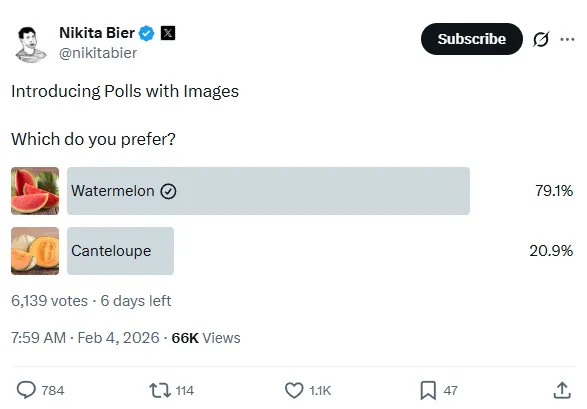
Meanwhile, X is adding images to in-stream polls, reinforcing the broader shift toward visual, low-friction engagement. Video and visuals collapse distance faster than text, helping brands spark interaction and trust through people, not polished messaging.
🗝️ Tweet of the Day

Advertise with Us
Wanna put out your message in front of over 50,000 best marketers and decision makers?
Checkout our Partner Kit here🤝
At Buyology, we care about our readers and want to provide the best possible experience. That's why we always look for ways to improve our content and connect with our audience. It would be amazing if you could hit us up with feedback about our content or absolutely anything, we are always up for a chat 🥰
Thanks for your support, We'll be back with more such content 🥳